
Best Boat Shoes: 14 Pairs Ranked for Grip, Comfort & Saltwater Survival
A slippery deck at the wrong moment is how good days turn bad. We wore, soaked, scuffed, and sailed in the most popular boat shoes on the market — from hand-sewn leather classics to purpose-built fishing shoes — to find out which ones actually hold when the deck gets wet.
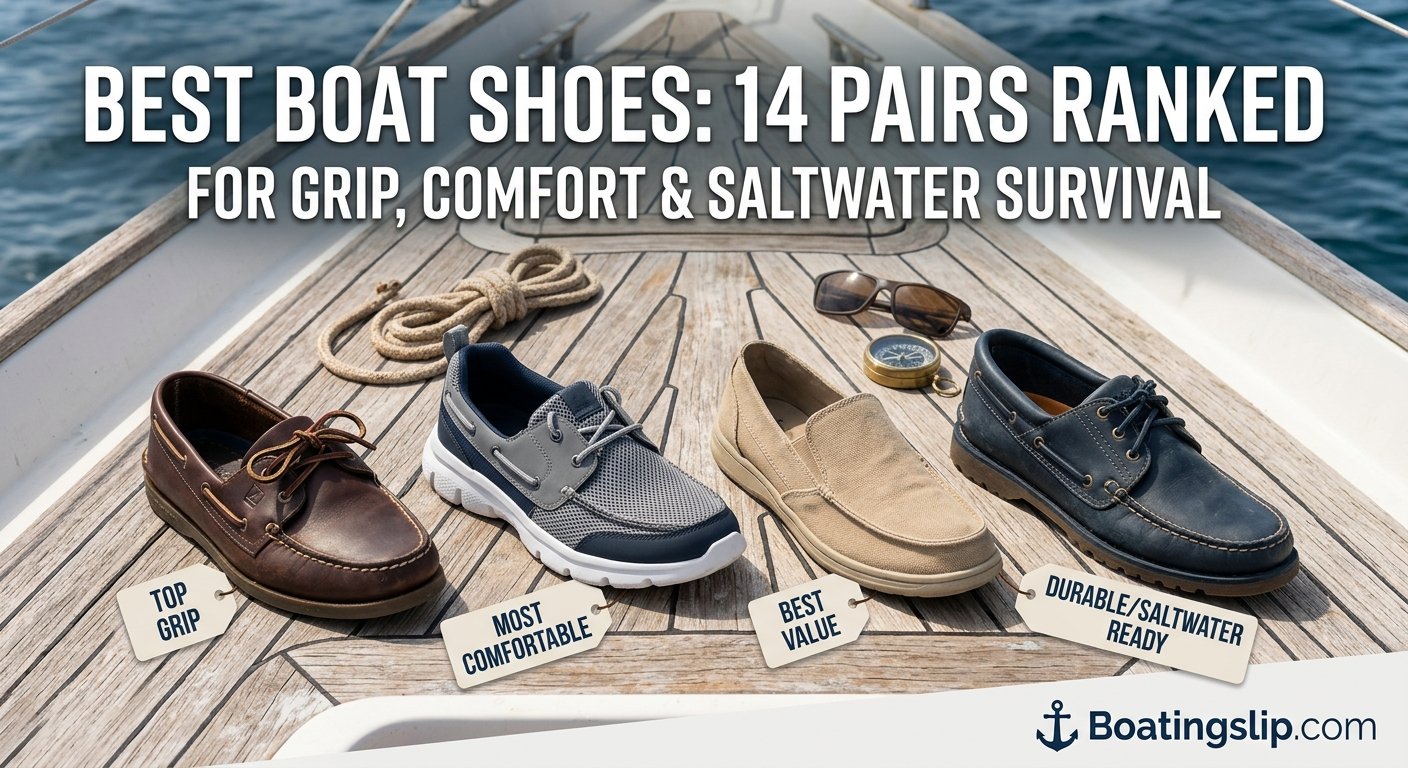
Boat shoes are safety gear disguised as style
Most people buy boat shoes for the look — the rawhide laces, the moccasin stitching, the way they pair with shorts on a Saturday at the marina. But the original purpose of this footwear was never fashion. It was traction: a soft, non-marking rubber sole cut with razor-thin sipes that channel water away from the contact patch, so a wet fiberglass deck doesn’t turn into a ski slope.
Once you think of them as equipment rather than accessories, the differences between models stop being cosmetic and start being practical. Leather uppers resist abrasion and last for years; mesh and synthetic uppers drain and dry faster. Wide, sticky outsoles suit fishing boats with standing water. Minimal, flexible shoes suit dinghies and travel. We break all of it down below — and we pair the footwear advice with the rest of the safety picture, because shoes are only one part of staying steady on the water. If you are still assembling your kit, our best boating clothes roundup is a natural companion piece.

What Actually Makes a Great Boat Shoe
Strip away the brand names and the marketing language, and every boat shoe on the market is solving one problem: keeping a human upright on a surface that is wet, moving, and often angled.
The boat shoe was born from a single observation. Back in the early days of performance sailing, it became obvious that leather dress shoes and hard rubber boots were useless the moment spray hit the deck. The fix was a shoe with a soft, grippy rubber sole and a drainage-friendly construction, cut low so the ankle stayed free for moving across a cockpit. Everything that followed — the 360-degree lacing system, the hand-sewn moccasin toe, the razor siping in the outsole — was iteration on that core insight.
Understanding those iterations matters when you shop, because modern boat shoes fall into three broad families. Heritage leather models are the direct descendants of the original design: full-grain uppers, hand-stitched seams, and soles that mold to your foot over time. Performance marine models borrow from athletic footwear, with cushioned midsoles, mesh panels, quick-dry linings, and drainage ports for water that inevitably gets in. And technical fishing and work models go further still, prioritizing aggressive outsoles and chemical-resistant materials for boats where the deck is a workplace, not a weekend lounge.
The outsole is the entire argument
If you remember one thing from this guide, make it this: the sole is the product. Uppers can be replaced by socks and spray; the sole is what stands between you and a hard landing on a hatch. The best marine outsoles use siping — tiny, densely spaced slits cut into the rubber, borrowed from tire technology. On a wet surface, those slits open slightly under load and create thousands of extra biting edges, channeling water out from under the shoe. Cheap imitations look similar from a distance but use hard, glossy rubber with shallow grooves that skate on wet fiberglass.
Second to grip is the non-marking requirement. A white deck shows every scuff, and darker rubber compounds can leave streaks that take real effort to remove. Reputable marine soles are explicitly formulated to leave no marks — a detail that separates genuine boat shoes from generic loafers dressed up with nautical branding.
Materials: leather, canvas, or synthetic
- Full-grain leather — the heritage choice. Breaks in beautifully, resists abrasion, and develops character. Needs occasional conditioning and dislikes repeated soak-and-bake cycles.
- Canvas and nubuck blends — lighter, more breathable, easier to rinse clean. A good middle ground for warm-weather boating and casual wear.
- Synthetic and mesh uppers — the fastest to drain and dry, and usually the lightest. These dominate the fishing and performance categories.
Which matters more depends on where you boat. If your shoes see saltwater spray twice a month and then a dinner dockside, leather rewards you with years of service. If you are standing in wash water all afternoon, synthetic uppers that drain through ports and dry in the sun will save you from the soggy-shoe misery that ruins an otherwise perfect run. And while we are on the subject of kit that prevents misery, a properly fitted PFD belongs in the same conversation — see our guide to the best life jackets for adults boating if yours is still an old foam vest from the garage.
Start with the classics
Browse thousands of listings and compare real-world reviews before you commit to a pair.
How to Choose: The Six Factors That Matter on Deck
Marketing copy will tell you everything about a shoe except the things that decide whether you keep it. Here is the checklist we actually use.
Walk into any marine store and the wall of boat shoes looks roughly interchangeable — same silhouettes, same lacing, same vocabulary. The differences that matter are quieter than the styling. After testing fourteen pairs across wet decks, gravel docks, and long travel days, we have settled on six decision factors. Weigh them in this order, and the right shoe for your situation tends to select itself.
1. Wet-deck traction
Ask two questions: does the outsole use genuine siping, and does the rubber feel soft and slightly tacky rather than hard and glossy? Press a thumbnail into an inconspicuous spot on a display shoe — quality marine rubber gives slightly. On the water, that softness is what allows the sole to conform to tiny surface irregularities instead of skating across them.
2. Drainage and drying speed
Water will get in. The question is how fast it gets out. Look for drainage ports in the midsole, hydrophobic linings that do not hold moisture, and uppers with mesh panels rather than fully sealed leather. A shoe that dries in two hours in the sun is worth more on a multi-day trip than a shoe with marginally better cushioning.
3. Fit and heel security
Boat shoes are slip-ons at heart, so heel slip is the enemy. The lacing system should pull the collar snugly around the midfoot, and the heel cup should hold without a break-in period of blisters. If you plan to move around a lot — fishing, dinghy work, dock lines — prioritize a secure heel over a roomy toe box.
4. Weight and flexibility
Every hundred grams matters more than you think by hour six. Lightweight models reduce fatigue and pack flat in a duffel, which is why they dominate our travel picks. Heavy, heavily cushioned shoes win on a floating dock where you stand all day.
5. Materials and maintenance tolerance
Be honest about your care habits. Leather that never gets conditioned will crack; synthetic mesh that never gets rinsed will hold salt crystals and chafe. The best shoe is one whose care routine you will actually follow.
6. Style versatility
Boat shoes are among the rare pieces of gear that cross from cockpit to restaurant without a costume change. If this is your only pair, pick a neutral leather color and a clean silhouette. If it is your third pair, buy for the task, not the mirror.
One last note on the broader kit: your footwear choice interacts with the rest of your safety setup. A grippy shoe is far more effective when combined with clear movement paths, handholds, and awareness of conditions. Our guide on what to do if you get caught in severe weather while boating covers the movement and preparation side of that equation.
Find your exact fit
Filter by size, width, and color across the full range of marine footwear in one search.
How We Tested & the Full Comparison Table
Fourteen pairs, four scoring criteria, and one non-negotiable requirement: every shoe here had to perform on a genuinely wet surface.
Our testing protocol is deliberately unglamorous. Each pair was worn for a minimum of a full day on the water, in conditions ranging from calm marina mornings to choppy afternoons with spray over the gunwale. We soaked every pair completely — dunking them and letting them drain — then timed how long they took to feel tolerable again. We walked wet fiberglass, teak, painted aluminum, and a slimy concrete boat ramp, scoring traction each time. And we logged comfort notes after four hours of continuous wear, because that is where cheap footbeds reveal themselves.
Four scores feed the rankings: Wet Grip, Comfort Over Time, Durability & Build, and Versatility (how well the shoe works both on and off the boat). Prices vary by size and color, so treat the range column as orientation rather than a quote.
| Shoe | Best For | Upper | Wet Grip | Comfort | Price Range |
|---|---|---|---|---|---|
| Sperry Authentic Original 2-Eye | Classic style, everyday wear | Full-grain leather | Excellent | Very Good | $$ |
| Sperry Billfish 3-Eye Leather | All-day cushioning | Leather + mesh | Excellent | Excellent | $$ |
| Sperry Sea Kite Sport Moc | Light athletic feel | Synthetic + leather | Very Good | Excellent | $$ |
| Columbia PFG Castback TC | Fishing, standing water | Synthetic + canvas | Excellent | Very Good | $$ |
| Columbia Bahama Vent PFG | Warm-weather fishing | Canvas + leather | Very Good | Very Good | $ |
| Dockers Vargas Classic Leather | Office-to-dock versatility | Full-grain leather | Good | Very Good | $$ |
| Nautica Lace-Up Boat Shoe | Budget casual wear | Leather + textile | Good | Good | |
| OluKai ‘Ahi Boat Shoe | Premium comfort & build | Premium leather | Excellent | Excellent | $$$$$ |
| Huk Rogue Wave Shoe | Serious fishing decks | Quick-dry synthetic | Excellent | Very Good | $$ |
| Astral Loyak Shoe | Travel, dinghy, minimal feel | Recycled textile | Excellent | Very Good | $$ |
| XtraTuf Tidewater Boat Shoe | Wet work, rugged use | Leather + rubber | Excellent | Good | $$ |
| Shimano Evair Marine Shoe | Anglers wanting easy on/off | Molded EVA + strap | Very Good | Very Good | |
| Chatham Pippa II G2 (Women’s) | Women’s classic styling | Full-grain leather | Very Good | Very Good | $$$$ |
| Skechers Go Walk Lite Boat | Cushioned walking comfort | Textile + leather | Good | Excellent | $ |
Two patterns jumped out immediately. First, the performance gap between genuine marine outsoles and fashion imitations is enormous — the top half of that table all use properly siped, soft-compound rubber, and it shows on a wet deck. Second, comfort and grip are no longer a trade-off. A decade ago you chose between a grippy, stiff fishing shoe and a soft, slippery casual one; several of the models in this list deliver both.
See today’s pricing
Boat shoe prices move constantly — check live availability across all fourteen models.
Best Classic Leather Boat Shoes
These are the shoes people picture when they hear “boat shoe” — and after weeks of testing, the originals still justify their reputation.
There is a reason the classic leather boat shoe has survived unchanged in silhouette for generations: it works. The hand-sewn moccasin construction moves with the foot, the leather upper resists the abrasion of cleats and ladders, and the lacing system that wraps 360 degrees around the opening keeps the shoe secure without a proper tongue. The two models below represent the classic idea at its purest and at its most cushioned.

Sperry Men’s Authentic Original 2-Eye Boat Shoe
Full-grain leather · Wave-Siping outsole · 360° lacing
This is the shoe every other boat shoe is measured against. The Authentic Original 2-Eye has been in continuous production for generations, and the formula has barely needed adjusting: a hand-sewn leather upper with genuine moccasin stitching, rawhide laces that thread through a collar-level channel so the entire opening cinches evenly, and a razor-siped rubber outsole that grips wet fiberglass like it owes it money.
What surprised us during testing was how well it coped outside its comfort zone. On a dew-slicked dock at seven in the morning, the siping bit confidently. On a warm afternoon of errands, the leather softened and molded rather than pinching. The break-in is real — expect two or three days of slightly stiff leather before the toe box relaxes — but once shaped to your foot, few shoes feel as deliberate.
The trade-offs are the obvious ones for leather. Repeated soakings without conditioning will stiffen and eventually crack the upper, and it is not the shoe to dunk repeatedly in saltwater. Treat it as your everyday and dockside pair, and it will outlast several pairs of synthetics.
- Hand-sewn moccasin construction with genuine leather lacing system
- Wave-Siping outsole engineered specifically for wet-surface traction
- Non-marking rubber sole safe on white gelcoat and teak
- Shock-absorbing heel cup for longer days on hard docks
- Breaks in to a custom-like fit over the first week
What We Liked
- Best-in-class wet-deck grip from a classic silhouette
- Leather ages beautifully and resists abrasion
- Genuinely wearable off the boat
- Secure 360-degree lacing with no heel slip
Worth Knowing
- Short break-in period before peak comfort
- Leather dislikes repeated full soaking
- Runs slightly narrow for wide feet
Sperry Men’s Billfish 3-Eye Leather Boat Shoe
Leather & mesh upper · Cushioned midsole · 3-eye lacing
If the Authentic Original is the tuxedo of the category, the Billfish 3-Eye is the performance sneaker that borrowed the tuxedo’s tailoring. The three-eye lacing and padded collar give it a more athletic fit, while mesh panels woven into the leather upper add the airflow that pure leather cannot match. It is the shoe we reached for on the longest days — marina mornings that stretched into dockside dinners without a stop home.
The cushioning story here is stronger than in the classic. A molded, shock-absorbing midsole handles hard surfaces like concrete ramps and metal docks, and the heel cup holds more aggressively thanks to the higher lacing. Wet grip remains excellent, with the same razor-siped outsole logic applied to a wider, flatter contact patch that suits standing for hours.
Where it gives ground to the pure classic is formality. The mesh panels and athletic lines read as “sporty” rather than “heritage,” which matters if you plan to wear them with a blazer at a yacht club. For everything else — especially if you spend hours on your feet — the Billfish is the smarter buy.
- Three-eye lacing for a more adjustable, athletic fit
- Air mesh panels for ventilation in hot conditions
- Stain- and water-resistant leather treatment on the upper
- Shock-absorbing midsole built for hard surfaces
- Non-marking, siped rubber outsole with reliable wet traction
What We Liked
- All-day comfort that rivals dedicated walking shoes
- Better ventilation than full-leather designs
- Secure heel hold for active movement on deck
- Fast break-in — comfortable almost immediately
Worth Knowing
- Sportier look is less dressy than the classic
- Mesh panels can trap grit without rinsing
Looking for the classic look?
Shop the full range of heritage leather boat shoes and find your colorway.
Best for All-Day Comfort on Deck
Some days on the water are measured in hours on your feet. These two pairs are built for that metric specifically.
Comfort is a deceptive quality in boat shoes, because everything feels fine for the first twenty minutes. The real test is hour four, when you have been shifting weight on a floating dock, climbing in and out of a dinghy, and standing at the helm. That is where footbed quality, midsole density, and heel geometry separate genuinely comfortable shoes from merely soft ones. The sport-moc and casual-leather entries below both passed the long-day test with room to spare.

Sperry Sea Kite Sport Moc Boat Shoe
Sport moc design · Breathable upper · Shock-absorbing sole
The Sea Kite Sport Moc is what happens when a boat shoe decides it wants to be a sneaker. The silhouette is lighter and more flexible than the heritage models, with a moc-toe that preserves the classic look while the rest of the shoe leans athletic. During testing it earned the “where did the day go” award — the kind of shoe you forget you are wearing until you take it off.
Flexibility is the standout characteristic. The forefoot bends easily, which matters more than expected when you are bracing against a moving deck or working a tiller with your feet. The upper breathes well in heat, and the cushioning stays supportive rather than collapsing flat after a few hours — a common failure in cheaper sport mocs.
Grip is very good rather than chart-topping: the siped outsole handles wet fiberglass and teak confidently, but on a truly slimy ramp you would want the more aggressive tread of a fishing-specific model. For recreational boating, sailing, and dock life, it is an easy recommendation.
- Lightweight sport-moc construction with easy flex
- Breathable upper that sheds heat quickly
- Shock-absorbing footbed for long standing sessions
- Razor-siped, non-marking outsole for wet decks
- Easy on and off for quick dock-to-cabin transitions
What We Liked
- Featherlight feel that reduces end-of-day fatigue
- Excellent breathability in hot weather
- Flexible enough for active dinghy and sailing use
Worth Knowing
- Less ankle security than laced 3-eye designs
- Sporty styling pairs best with casual wear

Dockers Vargas Classic Leather Boat Shoe
Full-grain leather · Cushioned insole · Timeless two-eye styling
Dockers built its reputation on the space between formal and casual, and the Vargas lands squarely in that territory. This is the boat shoe you can wear with chinos to a waterfront office and then straight to the marina without a costume change. The leather is supple from the first wear — noticeably softer out of the box than most heritage competitors — and the cushioned insole borrows from the brand’s comfort-shoe lineage.
On the water it behaves like a solid recreational boat shoe: the outsole grips well on wet fiberglass and finished teak, the non-marking rubber leaves decks clean, and the low profile keeps the look refined. It is not built for standing in wash water or working a commercial deck, and the sole siping is less dense than the marine-specialist models. But for the boater whose day is half sailing, half socializing, the versatility is the whole appeal.
Durability testing showed a well-stitched upper and a sole that bonded cleanly with no delamination signs after repeated wetting and drying. With occasional leather conditioner, this is a multi-season shoe.
- Supple full-grain leather that requires minimal break-in
- Cushioned comfort insole for extended wear
- Classic two-eye moc styling that reads dressy
- Non-marking rubber outsole for clean decks
- Reinforced stitching at high-stress seams
What We Liked
- Out-of-the-box comfort with almost no break-in
- Works equally well on deck and at dinner
- Strong build quality for the price tier
Worth Knowing
- Less aggressive wet grip than fishing-focused shoes
- Leather needs conditioning after saltwater exposure
Comfort you can stand in all day
Compare cushioned boat shoes side by side and pick the footbed that fits your routine.
Best Boat Shoes for Fishing & Performance Use
When the deck is a workplace and the water is a certainty, footwear gets technical fast.
Fishing changes the footwear equation entirely. You are standing for hours, often in a fighting stance with water sloshing over the deck. You need drainage rather than water resistance, aggressive tread rather than discreet tread, and uppers that survive fish scales, bait, and sun without complaining. Columbia’s PFG line was purpose-built for exactly this environment, and both entries below reflect that focus.

Columbia PFG Castback TC Boat Shoe
Omni-Shield upper · Drainage ports · Techlite cushioning
The Castback TC is the most purpose-driven shoe in this entire roundup. Everything about it answers a fishing problem. Water that enters through the top exits through drainage ports in the midsole rather than pooling around your foot. The upper treatment repels moisture and stains so bait juice and fish slime rinse clean. And the outsole compound is engineered for the wettest, slimiest surfaces a boat can produce.
In testing, the drainage performance was the headline. A complete dunking left the shoe noticeably lighter within minutes of stepping out of the water, and the footbed stayed tolerable rather than waterlogged. That single behavior transforms a long day — soggy footwear is the fastest route to cold, blistered, unhappy feet.
Comfort comes from a lightweight cushioning midsole that keeps its bounce through full days of standing. The fit runs true to size with a slightly roomy toe box that welcomes thicker fishing socks. If your boat sees real water and real work, this is the pair we would take.
- Water- and stain-repellent upper treatment for easy cleaning
- Midsole drainage ports that shed water fast
- Lightweight cushioning built for all-day standing
- Aggressive wet-traction outsole for slimy decks and ramps
- Quick-dry lining that limits chafing after soaking
What We Liked
- Best drainage performance in the test group
- Excellent grip on genuinely slippery surfaces
- Rinses clean after contact with bait and slime
- Light for how durable it feels
Worth Knowing
- Technical look is not a dress-shoe substitute
- Roomy toe box may feel loose on narrow feet

Columbia Bahama Vent PFG Boat Shoe
Canvas & leather upper · Ventilation ports · Omni-Grip outsole
The Bahama Vent takes the PFG fishing formula and softens it for warm weather and long, casual days. The canvas-and-leather upper breathes better than any full synthetic here, and the vent ports along the midsole let air — and water — move through the shoe freely. It is the model we reached for when the forecast promised sun, light chop, and hours of casting.
Comfort is the defining trait. The footbed is cushioned enough for a full day of standing, and the upper feels broken in almost immediately. Traction comes from a sticky, non-marking compound with a tread pattern that sheds debris rather than packing with gravel — a small detail that keeps grip consistent on mixed surfaces from sandy docks to metal ladders.
Compared with the Castback, it is less of a specialist. Drainage is good but not exceptional, and the lighter canvas upper trades some abrasion resistance for airflow. For hot-weather boating and inshore fishing, that trade works in your favor.
- Vented construction that maximizes airflow in heat
- Canvas and leather upper that balances breathability and durability
- Sticky, non-marking Omni-Grip rubber outsole
- Water-draining ports built into the midsole
- Cushioned footbed suitable for all-day wear
What We Liked
- Outstanding breathability for hot climates
- Comfortable with zero break-in
- Versatile enough for shore wear
Worth Knowing
- Canvas is less abrasion-resistant than full leather
- Drainage is good, not class-leading
Gear up for fishing season
Shop performance marine footwear built for wet decks and long days.
Best Premium, Style-Forward & Women’s Options
For boaters who want the deck performance without abandoning craftsmanship, fit nuance, or design.
Premium boat shoes earn their price in two places: materials and geometry. Better leather means a shoe that molds instead of creasing, better footbeds mean arch support that survives a decade, and better outsole compounds mean grip that does not harden and skate after a season in the sun. The three picks below cover the premium lifestyle space, the budget-stylish space, and the women’s-specific fit that unisex sizing never quite delivers.

OluKai ‘Ahi Boat Shoe
Premium leather · Wet-grip rubber · Contoured arch support
OluKai approaches boat shoes the way a surf brand approaches the ocean — with respect for the environment and an obsession with foot geometry. The ‘Ahi is the most refined shoe in this roundup. The leather is exceptional: rich, tight-grained, and supple enough that the break-in period feels more like a formality than a process. The contoured footbed supports the arch properly, which is rarer than it should be in this category.
Underneath, a wet-grip rubber compound delivers traction that matches the technical fishing models — an impressive trick for a shoe that looks this good. The drop-in heel design, allowing the back to be worn down like a slipper, adds a casual versatility that dock life rewards more than you would expect.
The obvious consideration is price. This is an investment shoe. But the construction quality — hand-finished details, precise stitching, a sole built to be resoled rather than discarded — means the cost-per-wear story is better than cheaper pairs replaced annually.
- Hand-selected premium leather with a soft, fast break-in
- Wet-grip rubber outsole tested on soaked fiberglass
- Contoured, anatomical footbed with genuine arch support
- Convertible drop-in heel for slip-on convenience
- Build quality designed for resoling and long service life
What We Liked
- Best materials and craftsmanship in the group
- Real arch support reduces end-of-day fatigue
- Grip that matches technical models in a dressy shoe
Worth Knowing
- Highest price point in this guide
- Limited width options

Nautica Lace-Up Boat Shoe
Leather & textile upper · Cushioned footbed · Casual nautical styling
Nautica brings the nautical aesthetic to an accessible price point, and the Lace-Up model delivers the look convincingly: clean lines, contrast stitching, and a silhouette that reads “marina” instantly. It is a genuinely good shoe for the boater who spends more time on the dock than on the deck, or who wants a stylish pair they will not mourn when they get scuffed on a cleat.
Comfort is solid for the category — a cushioned footbed and a flexible sole handle casual walking well. Where the price shows is in the details: the outsole compound is firmer than the marine specialists, so wet grip is good rather than exceptional, and the upper materials will not age with the character of premium leather. For dry-weather boating, dock parties, and summer wear, none of that matters much.
Our advice: treat this as your social pair, and keep a performance model aboard for genuinely wet conditions. Two pairs with different jobs beats one pair doing both badly.
- Classic nautical styling with contrast stitching detail
- Cushioned footbed for casual comfort
- Flexible, non-marking outsole for clean decks
- Easy-care upper materials that rinse clean
- Approachable price point for a first pair
What We Liked
- Authentic boat-shoe looks without the premium price
- Light and comfortable for casual wear
- Good value for dock-and-restaurant use
Worth Knowing
- Wet grip trails the marine-specialist models
- Materials show wear faster than premium leather

Chatham Pippa II G2 Boat Shoe (Women’s)
Full-grain leather · G2 non-marking sole · Women-specific last
The problem with “unisex” boat shoes is simple: they are almost always built on a men’s last, which means a wider heel and a looser midfoot for most women. The Pippa II solves this by using a genuinely women-specific shape, and the difference is immediately obvious. The heel locks, the arch sits where it should, and the shoe moves with the foot instead of sliding against it.
Chatham brings serious marine heritage to the construction. The G2 outsole is non-marking and properly siped, delivering wet-deck grip that stands alongside the best unisex models here. The full-grain leather upper is stitched to a high standard, and the styling keeps the classic profile without unnecessary embellishment.
Sizing is true, though the leather will relax slightly after the first week. If you have struggled with boat shoes that gape at the heel or pinch at the toes, this is the model that changes your mind about the category.
- Women-specific last for a precise, secure fit
- G2 non-marking, siped outsole for wet-deck traction
- Full-grain leather upper with quality stitching
- Cushioned insole with sensible arch placement
- Refined classic styling suitable on and off the water
What We Liked
- Proper women’s fit instead of shrunken unisex sizing
- Marine-grade outsole with real siping
- Durable leather that ages well
Worth Knowing
- Color selection is narrower than major brands
- Leather needs standard conditioning care
Style that survives the deck
Browse premium and women-specific boat shoes with marine-grade construction.
Best for Wet Work & Demanding Conditions
Commercial decks, charter boats, and serious fishing demand shoes that treat water as the default state, not the exception.
There is a category of boater for whom “waterproof” is a joke and “quick-dry” is the only honest promise. Charter crews, fishing guides, dock workers, and anyone who spends real hours in standing water need footwear built around the assumption that everything will get soaked. The three models in this section come from brands with working-water pedigrees, and it shows in every design decision.

Huk Rogue Wave Shoe
Quick-dry synthetic · Grip-X outsole · Full drainage design
Huk designs for anglers who measure days in casts, not cocktails, and the Rogue Wave is the purest expression of that philosophy. The upper is a quick-dry synthetic engineered to move water through rather than hold it, and the outsole is among the most aggressive in the test — a dense pattern of siped, sticky lugs that grips wet fiberglass, painted metal, and algae-slick ramps with equal confidence.
What sets it apart is consistency. Many shoes grip well when dry and degrade as the surface gets worse; the Rogue Wave’s performance barely changed as conditions deteriorated. That predictability is exactly what you want when you are moving quickly across a deck carrying gear.
Fit is secure with a snug midfoot and a heel that stays planted during active movement. Comfort is good for a technical shoe, though it does not have the plush cushioning of lifestyle models — the footbed is firmer, prioritizing stability and ground feel over softness. For real work on real water, that is the right trade.
- High-density siped outsole with best-in-class wet grip
- Quick-dry, water-shedding synthetic upper
- Full drainage construction that never waterlogs
- Secure, athletic fit for active deck movement
- Easy to rinse clean after fishing or deck work
What We Liked
- Most confident grip in deteriorating conditions
- Dries quickly between wet sessions
- Minimal maintenance — just rinse and go
Worth Knowing
- Firmer footbed than lifestyle boat shoes
- Technical styling is casual-only

XtraTuf Tidewater Boat Shoe
Leather & rubber construction · Chevron outsole · Work-boot DNA
If you know working boats, you know the brand — the boots that earn their keep on decks where the environment tries to defeat footwear daily. The Tidewater takes that toughness and shrinks it into a low-profile boat shoe. The construction feels overbuilt in the best way: thick leather panels, reinforced stress points, and a chevron-pattern outsole designed to shed mud, scales, and debris rather than pack them in.
Traction is exceptional on the messiest surfaces — slimy concrete ramps, wet metal, and decks with organic film. Where it differs from the lighter performance shoes is weight and flexibility: the Tidewater is sturdier and heavier, and the leather upper breaks in over a longer period. In exchange, it shrugs off abuse that would shred a mesh shoe.
This is the recommendation for anyone whose boat is a job site, or for recreational boaters who simply prefer gear that is built like equipment. Add a solid care routine — rinse after saltwater, condition the leather seasonally — and it will serve for years.
- Work-grade leather and rubber construction
- Chevron outsole that sheds debris and grips film
- Reinforced stitching at all high-stress points
- Stable platform suited to long standing
- Heritage brand trusted on working vessels
What We Liked
- Built tough enough for daily commercial use
- Grip that holds on the messiest surfaces
- Long service life with basic care
Worth Knowing
- Heavier than sport-oriented boat shoes
- Longer break-in for the leather upper

Shimano Evair Marine Shoe
Molded EVA construction · Secure strap · Ultra-lightweight
Shimano knows anglers, and the Evair marine shoe reflects a very specific insight: on a fishing boat, you are constantly on and off your feet, on and off the boat, on and off the trailer. A shoe that slips on instantly, drains completely, and rinses clean in seconds solves a hundred small annoyances per day.
The molded construction means there is no fabric to waterlog and no seams to fail. Water passes through instantly, and the shoe is dry to the touch remarkably fast in the sun. The strap keeps it planted during movement — far more secure than a generic clog — and the footbed features a textured pattern that keeps your foot from sliding inside the shoe when everything is wet.
Grip is very good on fiberglass and metal, though the tread is less aggressive than dedicated fishing shoes. Where it wins decisively is hygiene and convenience: nothing soaks, nothing smells, and cleaning is a two-second rinse. For warm climates and quick-turn trips, it is a superb second pair — or a primary one for boaters who value speed over style.
- Single-piece molded EVA that cannot waterlog
- Secure heel strap for confident movement
- Textured footbed that grips wet feet
- Ultra-lightweight construction reduces fatigue
- Rinses clean instantly after salt or bait exposure
What We Liked
- Instant on and off with reliable strap security
- Dries faster than anything else tested
- Hygienic, odor-resistant, and effortless to clean
Worth Knowing
- Less aggressive tread than specialist fishing shoes
- Casual appearance is not for dress settings
Ready for the wettest conditions
Shop technical marine shoes with aggressive grip and instant drainage.
Best Lightweight & Travel-Friendly Boat Shoes
When every ounce in the duffel counts and your feet want to feel the deck, minimal is the winning strategy.
There is a particular joy in a shoe that weighs almost nothing. Lighter footwear means less fatigue, more ground feel, and a packed bag that stays under the airline limit. The two models below represent the lightweight philosophy from opposite directions — one a technical minimalist built for real water, the other a walking-focused comfort shoe with nautical styling.
Lightweight packing also pairs naturally with the rest of a smart travel kit. Dry bags protect electronics and spare clothes when space and weight are tight, so it is worth building the whole system together — our roundup of the best dry bags for boating covers exactly that.

Astral Loyak Shoe
Recycled textile upper · Sticky G rubber outsole · Drainage ports
Astral built its reputation in the paddlesports world, where grip, drainage, and weight are everything — and the Loyak translates that expertise into a shoe that works beautifully as a boat shoe. It is astonishingly light, with a flexible sole that lets your foot do natural work, and an outsole compound that clings to wet rock, fiberglass, and wood alike.
The drainage design is simple and effective: ports in the sole let water escape the moment you step out, and the quick-dry textile upper holds almost no moisture. Environmental credentials are part of the package too, with recycled materials used throughout — a detail that matters to boaters who spend their lives on the water they want protected.
The minimal construction means less cushioning than a plush walking shoe. If you want maximum softness underfoot, look elsewhere. If you want to feel connected to the deck, pack light, and trust your footing on wet surfaces, the Loyak is one of the best-kept secrets in the category.
- Ultra-lightweight construction that packs flat
- Sticky rubber outsole with excellent wet-surface grip
- Drainage ports and quick-dry recycled textile upper
- Flexible, ground-feel-friendly sole
- Low-impact materials for the environmentally minded
What We Liked
- Among the best wet-grip performers in the test
- Incredibly light with excellent ground feel
- Dries fast and packs small for travel
Worth Knowing
- Minimal cushioning for all-day standing
- Casual, athletic appearance

Skechers Go Walk Lite Boat Shoe
Responsive cushioning · Lightweight textile upper · Flexible outsole
Skechers brought its walking-shoe expertise to the boat-shoe silhouette, and the result is one of the softest rides in this entire guide. The responsive cushioning footbed bounces back step after step, making this an outstanding choice for boaters who walk the docks, tour shore towns, and log serious mileage on vacation days.
The upper is light and forgiving, with a flexible outsole that moves naturally through each stride. Styling keeps the classic boat-shoe vocabulary — lacing, moc stitching, low profile — so it reads appropriate in marina settings while feeling like a walking shoe underneath.
On genuinely wet decks, grip is adequate rather than outstanding; the outsole compound is optimized for comfort and everyday surfaces. Think of this as your shore-side and dry-weather companion — brilliant for long walks and travel days, and a smart pairing with a more technical pair for wet work aboard.
- Highly responsive cushioning for long walking days
- Lightweight, flexible construction
- Classic boat-shoe styling that stays casual-smart
- Easy to slip on for quick departures
- Great value for comfort-focused boaters
What We Liked
- Exceptional comfort for walking and travel
- Very light with a forgiving fit
- Versatile styling for shore days
Worth Knowing
- Wet-deck grip is good, not class-leading
- Less durable under hard marine abrasion
Travel light without losing grip
Shop lightweight boat shoes that pack small and perform on wet decks.
Fit, Sizing & the Break-In Playbook
The best boat shoe in the wrong size is the wrong boat shoe. Here is how to get fit right the first time.
Footwear sizing is where good shopping decisions go to die. Online ordering makes it worse: you cannot walk a wet ramp in a product photo. But boat shoes are actually more forgiving than most categories, because their construction and materials behave in predictable ways. Once you understand those behaviors, ordering confidently becomes straightforward.
How a boat shoe should fit on day one
Expect a snug fit initially. The heel should feel secure with minimal lift as you walk, the midfoot should feel held rather than squeezed, and your toes should sit close to the front without pressing hard against it. Slight snugness at the sides is normal and desirable with leather — it will relax. Pain is not normal and will not resolve; size up rather than toughing it out.
| Fit Zone | Day-One Feel | After Break-In | Warning Sign |
|---|---|---|---|
| Heel | Firm, minimal lift | Locked in, no slip | Heel lifts with every step |
| Midfoot | Held snug by lacing | Secure and natural | Laces must be strangled tight to hold |
| Toes | Close, not compressed | Roomy and relaxed | Numbness or pressure points |
| Arch | Noticeable support | Contoured to your foot | Flat, collapsed feeling underfoot |
Leather vs. synthetic: what to expect
Leather stretches — typically a quarter to a half size in width over the first week of wear, while holding length. This is why leather boat shoes should start slightly snug. Synthetics and mesh do not stretch meaningfully; what you feel on day one is what you will feel on day one hundred. With synthetic models, sizing errors need to be corrected at purchase, not broken in.
Width, socks, and the afternoon rule
Boat shoes are traditionally worn without socks or with no-show liners, which changes fit significantly. If you plan to wear socks, try your sizing with the same weight of sock you will use on the water. And always measure or try shoes on in the afternoon, when feet are slightly swollen — the same condition they will be in after hours of standing on deck. This single habit eliminates a surprising number of sizing mistakes.
A simple break-in protocol
- Day one: wear around the house for two to three hours. Nothing more.
- Days two to three: short outings on dry surfaces. Flex the forefoot by hand if any area feels stiff.
- Day four onward: normal use. Leather will have conformed noticeably.
- After the first week: apply a light coat of leather conditioner to leather models — it accelerates softening and adds water resistance.
Getting footwear right is one half of the comfort equation; the other half is everything else you bring aboard. If you are building out a complete loadout, start with the essentials in the right order — our guide to what type of life jacket is required for boating is a good place to anchor those priorities.
Find your true size
Many listings include detailed fit feedback — use it to lock in the right size before ordering.
Care, Cleaning & Making Boat Shoes Survive Saltwater
Salt is the quiet destroyer of marine gear. A five-minute routine is the difference between one season and five.
Nothing degrades boat shoes faster than neglect after saltwater exposure. Salt draws moisture out of leather, crystallizes inside stitching where it acts like tiny abrasives, and accelerates the breakdown of foam midsoles and adhesives. The good news: the countermeasures are cheap, fast, and require no special equipment. Boaters who rinse gear after every saltwater outing consistently report dramatically longer service life — and the same principle applies across all your equipment.
The five-minute post-trip routine
- Rinse immediately. Fresh water, inside and out. This single step does most of the work.
- Shake out debris. Sand and grit trapped in siping grinds away at the rubber during walking.
- Stuff and dry. Crumpled newspaper or quick-dry towels inside absorb moisture and hold shape. Air dry in shade — never direct, prolonged sun or a heater.
- Condition leather weekly during heavy use, monthly otherwise.
The drying mistakes that ruin shoes
Heat is the enemy. Leaving shoes on a hot dashboard or beside an engine-room vent bakes the adhesives that bond the sole to the upper, and cooked leather cracks along flex lines. Dry slowly, in shade, with airflow. If a shoe is soaked through, expect a full day to dry properly — and rotate between two pairs if you boat frequently. Owning two mid-priced pairs genuinely beats owning one premium pair worn daily while wet.
Deep cleaning when things get grim
For synthetics and mesh: mild soap, soft brush, rinse, dry. For leather: a barely-damp cloth, dedicated leather cleaner, then conditioner once fully dry. Never put boat shoes in a washing machine or dryer — the tumbling tears stitching and the heat deforms midsoles. If salt staining appears on leather as a white haze, a slightly damp cloth followed by conditioner removes it almost every time.
Storage between trips
Cool, dry, and ventilated. Avoid sealed plastic bins where trapped moisture breeds mildew, and avoid hot garages where temperature swings cook materials. Cedar shoe trees in leather pairs are a small investment that pays dividends in shape retention and odor control.
And remember that maintenance extends well beyond footwear. Storm preparation is part of the same protective mindset — if the forecast looks unsettled, our guide on getting caught in severe weather while boating covers the decision-making that keeps a maintenance problem from becoming a safety problem.
Refresh your rotation
Rotating pairs is the single best thing you can do for shoe longevity. Grab a second pair.
Use Cases: Dock, Deck, Dinghy & Shore
Different environments reward different shoes. Match the footwear to the task and both comfort and safety improve.
Ask five boaters what they want from a boat shoe and you will get five answers, because “boating” covers everything from a calm afternoon on a pontoon to a week-long coastal passage. The useful question is not which shoe is best overall — it is which shoe is best for what you are about to do. Here is how we think about matching footwear to environment, based on where each model in this guide performed strongest.
Marina life and dock walking
Hard surfaces, occasional splashes, and a strong social component. This is classic boat-shoe territory: leather uppers, clean styling, dependable grip on painted concrete and teak decking. The Sperry Authentic Original and Dockers Vargas thrive here, as does the Chatham Pippa II for women. Comfort matters more than drainage, and looking composed matters more than usual.
Active sailing and deck work
Movement is constant, the deck is often heeled, and lines underfoot are a real hazard. Prioritize secure heel hold, flexible soles for feeling the deck, and light weight to reduce fatigue. The Sea Kite Sport Moc and Astral Loyak both performed superbly in these conditions, with grip that held while moving quickly across a wet cockpit.
Fishing and working boats
Standing water, organic films, and long hours on your feet define this environment. Drainage and aggressive tread are non-negotiable — the Columbia PFG Castback, Huk Rogue Wave, and XtraTuf Tidewater were built precisely for this. Everything else is secondary to staying upright.
Dinghy and tender runs
Short, wet, unstable, and requiring quick footwork. Shoes that drain instantly and grip wet fiberglass matter here — and quick on-and-off capability is genuinely useful when boarding. The Shimano Evair and Astral Loyak both suit dinghy work particularly well.
Shore excursions and travel days
When the boat is at anchor and the day involves walking village streets, climbing headlands, or navigating cobblestone docks, cushioning and light weight win. The Skechers Go Walk Lite and Billfish 3-Eye both handle serious walking while keeping the nautical look intact.
Boating competence extends beyond gear into preparation and knowledge. If you are charting a longer adventure such as the Great Loop, or sharpening your navigation skills with a guide to how to read a nautical chart, the same principle applies: prepare deliberately, and the good days keep coming. Route planning tools help enormously too — our list of the best boating apps covers everything from navigation to weather.
Ready for your next outing
Whatever your boating style, there is a pair in this list built for it. Check current pricing before sizes disappear.
Frequently Asked Questions About Boat Shoes
The questions boaters actually ask — answered without the marketing gloss.
What makes a boat shoe different from a regular loafer or sneaker?
Three things: a siped rubber outsole designed for wet-surface grip, a non-marking sole compound that will not scuff gelcoat or teak, and a construction that tolerates water exposure. Regular loafers use hard leather or smooth rubber soles that skate dangerously on wet fiberglass, and ordinary sneakers absorb and hold water while leaving dark marks on white decks.
Are boat shoes actually non-slip on wet surfaces?
Genuine boat shoes with siped, soft-compound rubber outsoles are among the grippiest footwear you can wear on a wet deck. The siping creates thousands of additional contact edges that bite into smooth surfaces. That said, no shoe is slip-proof on algae-covered ramps or heavily oiled surfaces — footwear is one part of safe movement, not a guarantee.
Should you wear socks with boat shoes?
Traditionally, no — boat shoes are designed for bare feet or no-show liner socks, and the classic look assumes sockless wear. Practically, no-show liners are worth considering: they reduce friction, absorb moisture, and minimize odor without changing the appearance. If you prefer regular socks, size accordingly and embrace a more casual styling approach.
How do I clean saltwater out of leather boat shoes?
Rinse them with fresh water as soon as possible after exposure, inside and out, then stuff with newspaper and air dry in shade. Once completely dry, apply a quality leather conditioner to restore oils the salt has drawn out. Never use direct heat or a machine dryer — both destroy adhesives and crack leather.
Can boat shoes get wet, or should I keep them dry?
All boat shoes handle occasional wetting — that is the entire point of the category. The difference is in recovery. Synthetic and mesh models drain and dry fastest and can be soaked routinely without complaint. Leather handles periodic exposure well if rinsed and conditioned afterward, but repeated full soakings without care will shorten its life.
Do I need a boating license to operate a boat?
Requirements vary significantly by location, age, and vessel type. Many jurisdictions require boater education or a license for certain operators. Our general guide to whether you need a boating license explains the broad framework, and specific state guidance is available for Florida, Texas, and North Carolina.
How do I get a boating license if one is required where I live?
Usually through an approved boater-education course followed by a certification exam, with online options widely available. The step-by-step process is covered in our guide on how to get a boating license. Requirements and renewal cycles differ by jurisdiction, so check local regulations before signing up.
Do you need a boating license to rent a boat?
Often the rental company handles temporary authorization, but many places still require proof of boater education or a quick on-site safety briefing and exam. Rules vary widely — our explainer on boating licenses for boat rentals walks through the common scenarios.
Do you need a boating license for a jet ski?
In most jurisdictions, personal watercraft fall under the same boater-education requirements as motorboats — and some impose additional age or supervision rules. Our guide on boating licenses for jet skis covers the specifics worth checking before you head out.
How long does a boating license last?
It depends entirely on the issuing jurisdiction. Some certifications are lifetime credentials, others require periodic renewal, and some are tied to the validity of an education card. Our overview of how long a boating license lasts breaks down the typical patterns.
How many pairs of boat shoes should I own?
Two pairs used on rotation is the sweet spot for anyone who boats regularly. Rotating allows each pair to dry completely between outings, which dramatically extends the life of adhesives, midsoles, and leather. A common and effective setup: one classic leather pair for dock and social use, plus one performance pair for wet work and fishing.
Are boat shoes good for hiking or walking long distances on shore?
Lightly, yes — models with cushioned midsoles like the Billfish 3-Eye or Skechers Go Walk Lite handle shore walking well. But boat shoes lack the ankle support, aggressive tread, and toe protection of hiking footwear, so keep them to moderate distances and maintained paths. For serious shore hikes, pack dedicated shoes.
Still deciding?
Browse customer reviews and real photos to see how each pair holds up in the wild.
Final Thoughts: Which Boat Shoes Should You Buy?
After weeks of soaking, scuffing, and genuinely living in fourteen different pairs, the honest answer is that there is no single best boat shoe — only the best boat shoe for how you actually use your boat. That said, three models clearly led their categories. The Sperry Authentic Original 2-Eye remains the definitive classic, with wet grip that embarrasses shoes costing far more and a silhouette that never goes out of style. The Columbia PFG Castback TC is the performance champion, draining faster and gripping harder than anything else in wet, working conditions. And the OluKai ‘Ahi proves that premium materials and genuine arch support are worth paying for when footwear becomes a daily companion rather than an occasional accessory.
Whatever you choose, remember the two rules that matter most. Fit comes first — a properly sized mid-tier shoe beats an ill-fitting premium one every single time. And care comes second: rinse after saltwater, dry in shade, condition the leather, and rotate your pairs. Do those things and even a modest boat shoe will serve faithfully for many seasons.
Boat shoes are the beginning of a well-prepared life on the water. They are also, in a small but meaningful way, a statement about how seriously you take the environment you are operating in. Take care of your feet, take care of your gear, and the days get longer and better.