

Boating Gear Guide · Tested & Compared
Best Dry Bags for Boating
Eighteen roll-top sacks, floating backpacks, and bombproof duffels — compared side by side so your phone, clothes, and lunch come home as dry as they left the dock.
There is a specific, quiet panic that every boater knows: the moment a wave crests the gunwale, the moment a bag tips on a wet seat, the moment rain arrives sideways and the day’s dry clothes, car keys, and phone are sitting in an open tote. Water on a boat is not a possibility — it is the entire premise. That is exactly why a good dry bag is less of an accessory and more of a baseline piece of boating equipment, right alongside a properly fitted life jacket and a charged VHF.
But “dry bag” covers a huge range of gear. There are featherweight roll-top sacks meant to live inside a bigger pack, floating backpacks designed for kayak and paddleboard days, heavy-duty duffels built for multi-day cruises, and premium sealed bags that cost more than some tackle boxes. The differences matter enormously on the water. A bag that is perfectly fine for a gym shower can fail spectacularly after an hour of spray on a center console.
For this guide we focused on eighteen bags that show up again and again in boaters’ kits — from the do-everything Earth Pak Waterproof Dry Bag to the expedition-grade Watershed Dry Duffel. We looked at closure design, fabric feel, carry comfort, how each bag behaves when it goes overboard, and how easy it is to live with on a rocking deck. Whether you are running a bass boat on a lake, chartering a sailboat for a week, or dragging gear across a sandbar to a beach picnic, there is a bag here that fits how you actually boat.

A quick note on how to read this guide: we lead with an at-a-glance comparison table so you can scan all eighteen options in one place, then go deep on each one in category-based sections. Along the way you will find buying advice, waterproofing science, care tips, and a safety section that connects your dry bag setup to the rest of your boating preparedness. Let’s get into it.
Quick Comparison: Our Top Picks
Every bag in this guide is listed below, ranked for on-water use. Scroll the table horizontally to see specs and pricing links — the rank-one row is our overall top pick for most boaters.
Swipe to see more →
| # | Image | Product | Key Specs | Verdict | Link |
|---|---|---|---|---|---|
| 1 | |
Top PickEarth Pak Waterproof Dry BagBest Overall | Roll-top closure · Welded seams · Wide size range · Includes shoulder carry | The do-everything bag most boaters should buy first. | Check Price on Amazon |
| 2 |  |
HEETA Waterproof Dry BagBest Budget Roll-Top | Roll-top closure · Visible panel option · Lightweight fabric · Multiple sizes | Affordable, honest protection for casual days afloat. | Check Price on Amazon |
| 3 | 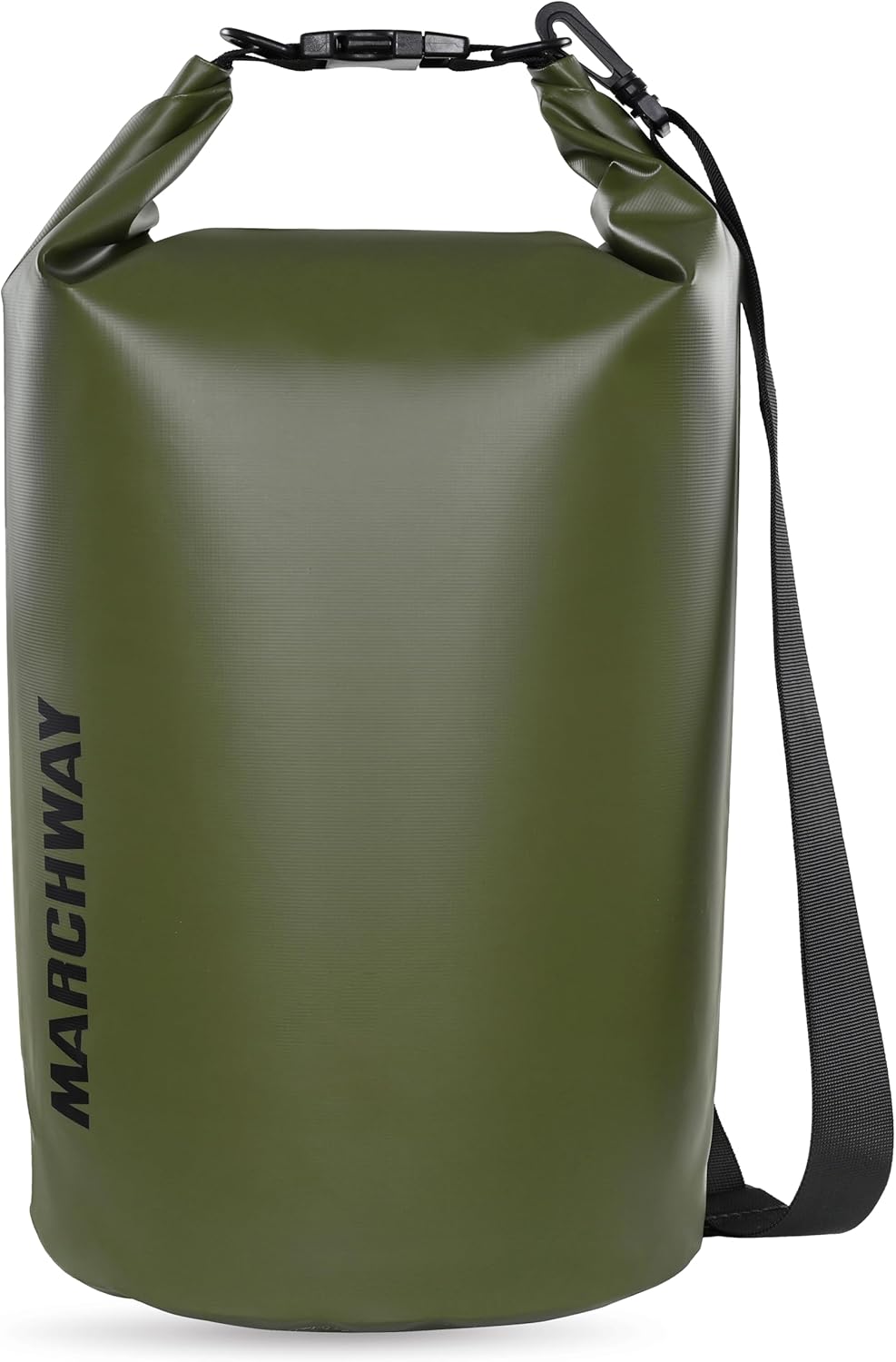 |
MARCHWAY Floating Dry Bag BackpackBest Floating Backpack | Backpack straps · Floats when sealed · Roll-top closure · Compact profile | Doubles as a daypack and a flotation-friendly gear bag. | Check Price on Amazon |
| 4 |  |
Unigear Waterproof Dry BagBest Value All-Rounder | Roll-top closure · Abrasion-minded fabric · Shoulder strap · Size variety | Hard to beat as a spare bag you keep stowed in a locker. | Check Price on Amazon |
| 5 |  |
Sea to Summit Big River Dry BagBest for Rugged Expeditions | Heavy-duty fabric · Roll-top closure · Reinforced base · Lash points | Built to be dragged, lashed, and abused on deck. | Check Price on Amazon |
| 6 | |
YETI Panga Waterproof DuffelBest Premium Duffel | Submersible-grade closure · Duffel carry · Rugged shell · Structured shape | The splurge that feels like it will outlast the boat. | Check Price on Amazon |
| 7 |  |
Osprey Ultralight Dry SackBest Ultralight Organizer | Featherweight build · Roll-top closure · Packs tiny · Great as liner | Barely registers on a scale but saves the day when spray hits. | Check Price on Amazon |
| 8 |  |
Pelican Waterproof Dry BagBest for Hard-Use Gear | Tough fabric · Roll-top closure · Protective base · Trusted brand pedigree | A no-nonsense hauler from people who build hard cases. | Check Price on Amazon |
| 9 |  |
Haimont 60L Waterproof Dry DuffleBest Large-Capacity Duffel | 60L capacity · Duffel format · Roll-top closure · Multiple carry options | Swallows a week’s worth of crew gear without complaint. | Check Price on Amazon |
| 10 |  |
SKOG Å KUST DrysåkBest Stylish Roll-Top | Roll-top closure · Clean styling · Welded construction · Everyday-friendly | Looks sharp on a marina dock and still handles real spray. | Check Price on Amazon |
| 11 |  |
SealLine Discovery View Dry BagBest Visibility | Clear viewing panel · Roll-top closure · Proven paddling heritage · Lash tabs | See what’s inside without breaking the seal — a real deck advantage. | Check Price on Amazon |
| 12 |  |
STOVER Waterproof Dry Bag BackpackBest Day-Trip Backpack | Backpack carry · Roll-top closure · Padded straps · Deck-friendly profile | A straightforward dry backpack for shore excursions and dinghy rides. | Check Price on Amazon |
| 13 |  |
MIER 30L Waterproof Dry BackpackBest Organized Backpack | 30L capacity · Backpack straps · Pocket organization · Roll-top closure | For boaters who hate digging through one big cavern. | Check Price on Amazon |
| 14 |  |
GVANCA 35L Waterproof Dry BackpackBest Comfort-First Backpack | 35L capacity · Padded back panel · Roll-top closure · Balanced carry | Comfortable enough to haul down a long dock without complaint. | Check Price on Amazon |
| 15 |  |
AquaQuest Rogue Dry BagBest for Heavy Rain & Spray | Waterproof fabric · Roll-top closure · Abrasion resistance · Compact storage | Takes a soaking with total indifference — a wet-weather favorite. | Check Price on Amazon |
| 16 |  |
Piscifun Floating Dry Bag BackpackBest for Fishing Trips | Backpack format · Floats when sealed · Roll-top closure · Angler-friendly sizing | Made for people who measure days in casts, not miles. | Check Price on Amazon |
| 17 |  |
Frelaxy Dry Sack 5-PackBest Packing System | Five-sack set · Multiple sizes · Roll-top closures · Ultra-packable | Color-code the whole family’s gear in one shot. | Check Price on Amazon |
| 18 |  |
Watershed Dry DuffelBest Bombproof Duffel | Sealed closure system · Heavy-duty shell · Duffel carry · Expedition heritage | The bag guides reach for when failure is not an option. | Check Price on Amazon |
Section 01
Why Dry Bags Belong on Every Boat
Ask a hundred boaters what they lost to water damage and you will hear the same chorus: phones, wallets, extra clothes, towels, snacks, cameras, paperwork, and at least one sentimental hat that never quite recovered. A boat is a wet environment wearing a dry disguise. Even on a calm lake, there is humidity, condensation, splash from the wake, the drips that run off an anchor line, and the mysterious puddle that appears under every cooler.
A dry bag solves this with a deceptively simple idea: roll the top down several times, buckle it shut, and you have created a barrier that keeps water out (and, just as usefully, keeps wet things in). The second half of that equation matters more than people realize. Tossing a soaked swimsuit or a dripping dock line into a sealed dry bag protects everything else in your bilge or trunk on the drive home.
What actually goes in a dry bag on a typical day
- Electronics and documents — phone, battery pack, keys, wallet, boat registration papers.
- A complete change of clothes — because someone always ends up wetter than planned.
- Layers and outerwear — windbreakers and rain shells that you want ready, not soaked. Pair them with quick-drying layers from our guide to the best boating clothes so damp gear stays manageable.
- Food and dry goods — bread, snacks, coffee, anything that turns to mush when wet.
- Medical and safety supplies — a small kit that must stay functional no matter the weather.
There is also a lifestyle argument. When your gear is protected, you say yes to more. You anchor and swim instead of hovering near the dock. You take the dinghy to shore without doing mental math about what happens if a wave comes over the bow. You keep footwear you actually like — see our picks for the best boating shoes — instead of defaulting to whatever survives getting soaked.
Finally, dry bags are gloriously simple. No zippers to corrode, no compartments to drain, nothing to latch shut with two hands while the boat rolls. You stuff, roll, clip, and go. On a list of boating upgrades ranked by “problem solved per dollar spent,” a good dry bag sits near the very top.
Section 02
How We Evaluated These Bags
Every bag on this list earned its place by being useful on a boat specifically — not just “waterproof” in the abstract. Plenty of dry sacks perform fine in a shower test and then frustrate you at sea, usually because of how they carry, how they pack, or how the closure behaves when your hands are wet and the deck is moving. Here is the framework we applied across all eighteen products.
The five things that decide a dry bag’s fate on the water
- Closure integrity. The roll-top is the whole game. We looked for stiffened or structured top bands that roll cleanly, buckles that click shut without fumbling, and closures that do not slowly unroll under tension.
- Construction quality. Welded or taped seams are preferred over simple stitching at the waterproof boundary. Fabric weight, base reinforcement, and how the bag handles abrasion against non-skid and fiberglass all factored in.
- Carry and deck behavior. A bag that is comfortable on your shoulder for a long dock walk, that can be lashed to a rail, and that stands or lies without rolling into the scupper has a permanent advantage.
- Real-world capacity. Stated volume is one thing; usable volume is another. A shape that swallows a jacket, a towel, and a lunch box beats a bigger bag with awkward proportions.
- Value and durability outlook. We favor bags that will survive seasons of UV, salt, and sand over bags that feel disposable after one trip.
We deliberately avoided leaning on any single number. Capacities, weights, and exact dimensions shift with product updates, and quoting them loosely is how gear guides end up misleading people. Where a size appears in a product’s own name — the Haimont 60L, the MIER 30L, the GVANCA 35L — it is fair to reference. Everything else is described in terms of what the bag is genuinely good for, which is ultimately what matters when you are loading a boat at dawn.
We also considered who each bag is actually for. A kayak angler and a family on a pontoon have almost nothing in common gear-wise, and the right recommendation for one is often wrong for the other. That is why this guide is organized by bag type — roll-tops, backpacks, duffels, premium specialty bags, and ultralight organizers — rather than a single undifferentiated ranking.
Section 03
What to Look For in a Boating Dry Bag
Before you buy, it pays to understand the anatomy of a dry bag. The category looks uniform from the outside — colored cylinders with rolled tops — but small design decisions make enormous differences once you are wet, tired, and trying to find your car keys in a swell.
Closure type
The roll-top remains the gold standard for boating: simple, reliable, and field-repairable. Some premium duffels use a more elaborate sealed closure that behaves like a true submersible barrier, which is wonderful until you are trying to open it with cold hands. Zippers, when they appear on “dry” bags, are usually a water-resistant compromise rather than a true seal — fine for splash exposure, risky for full submersion.
Fabric and seams
Look for fabrics that feel substantial rather than papery, and for seams that are welded or taped rather than purely stitched. Stitching introduces holes; on a genuinely waterproof bag, those holes are sealed after the fact. A reinforced bottom panel is a quiet luxury — it keeps the bag from wearing through where it contacts rough decks and gravel launch ramps.
Size strategy
Boaters almost always own more than one bag eventually, so think in terms of a system. A small sack for phone and keys, a mid-size roll-top for clothes and lunch, and a large duffel for overnight trips covers nearly every scenario. Buying a single enormous bag “to cover everything” tends to backfire: it becomes a heavy, shapeless lump that is awkward to stow and impossible to find things in.
Carry, lash, and stow
Shoulder straps, backpack straps, grab handles, and lash points all matter more afloat than ashore. Anything that can be tied off to a rail or a seat base will not end up overboard when the boat accelerates. Backpack-style bags are the winners for shore excursions and dinghy runs; duffel handles win for loading into lockers.
Extras worth having
- Clear or translucent panels so you can identify contents without opening the seal.
- Light-colored interiors that make small items easier to find.
- Removable straps, so the bag can go streamlined when stowed.
- Grab loops that make hauling a loaded bag out of a deep locker painless.
And remember that the dry bag is only one node in your comfort system. Cold drinks and snacks live happily beside it in one of the best coolers for boating, and polarized eyewear from our rundown of the best boating sunglasses belongs clipped to your person rather than floating loose in a bag you have to seal to stay dry.
Section 04 · Product Reviews
Roll-Top Dry Bags Reviewed
The classic roll-top is where most boaters should start. These bags are simple, versatile, and available at every price point. They stack neatly in lockers, they double as wet-garbage bags on the way home, and when sized correctly they protect everything a day trip demands. Here are four that represent the best of the breed.
Swipe to see more →
| Product | Best For | Highlights | Link |
|---|---|---|---|
| Earth Pak Waterproof Dry Bag | Best Overall | Welded build, wide size range, shoulder carry | Check Price |
| HEETA Waterproof Dry Bag | Best Budget | Lightweight, visible panel options, multi-size | Check Price |
| Unigear Waterproof Dry Bag | Best Value | Abrasion-minded fabric, grab-and-go simplicity | Check Price |
| SKOG Å KUST Drysåk | Best Style | Clean design, welded seams, everyday appeal | Check Price |
Earth Pak Waterproof Dry Bag
If you only ever own one dry bag, this is the shape of bag you want. The Earth Pak has become the default recommendation in boating circles for a reason: it does the fundamentals extremely well and comes in a range of sizes that lets you match the bag to the trip rather than the other way around.
Key Features
- Roll-top closure with a structured band that rolls down cleanly and buckles securely.
- Welded construction that eliminates the weak points of stitched seams.
- Available across a wide span of capacities, from personal-size sacks to load-hauling versions.
- Carry options including shoulder strap and grab handles for deck-side handling.
What We Like
- Excellent all-around protection for typical boating splash and rain exposure.
- Size range means you can buy the exact right volume for your setup.
- Simple, proven design with no fussy hardware to fail.
- Packs flat when empty and stows easily in a locker.
Keep in Mind
- Single-compartment design means small items can sink to the bottom.
- You will want a small pouch inside for keys and phone organization.
HEETA Waterproof Dry Bag
Not every dry bag needs to be an heirloom. The HEETA is the bag you buy when you want honest splash protection, a friendly price, and a design that is light enough to toss in a daypack as a backup. It has quietly earned a following among casual paddlers and weekend boaters who want protection without premium pricing.
Key Features
- Lightweight fabric that keeps the empty bag easy to carry and stow.
- Roll-top closure with the standard fold-and-buckle seal.
- Offered in multiple sizes so families can grab a set for different uses.
- Often configured with a clear panel so contents are visible at a glance.
What We Like
- Approachable price makes it easy to own several.
- Light enough to carry as a dedicated “valuables” bag.
- Clear-panel versions help you find things without unsealing.
Keep in Mind
- Lighter fabric trades some abrasion resistance for weight savings.
- Best treated as a splash-and-rain bag rather than an expedition hauler.
Unigear Waterproof Dry Bag
The Unigear sits in the sweet spot most shoppers actually want: tougher than the bargain options, less expensive than the premium names, and simple enough that anyone in the family can close it correctly on the first try. It is the archetypal “keep one in the truck” bag.
Key Features
- Fabric selected with abrasion in mind, handling rough decks and gravel ramps gracefully.
- Roll-top closure with buckle, in the proven format.
- Shoulder strap included on most configurations for hands-free carry.
- Multiple sizes to cover everything from keys to full gear loads.
What We Like
- Strong value for the build quality on offer.
- Durable enough to leave in the boat year-round.
- Uncomplicated design that guests and kids can operate instantly.
Keep in Mind
- Styling is utilitarian rather than fashion-forward.
- Like most roll-tops, organization requires internal pouches.
SKOG Å KUST Drysåk
Some dry bags look like survival equipment. The Drysåk looks like something you would happily carry through a marina village and into a waterfront lunch. It pairs clean Scandinavian-influenced styling with genuinely practical construction, which is a rarer combination than it should be.
Key Features
- Refined aesthetic that works on and off the boat.
- Welded construction at the seams for reliable waterproofing.
- Roll-top closure that maintains the bag’s clean lines when sealed.
- Everyday-friendly sizing that suits valuables and personal items.
What We Like
- Genuinely good-looking — no trade-off between style and function.
- Welded seams inspire confidence in real wet conditions.
- Transitions easily from boat bag to travel tote.
Keep in Mind
- Style-focused design means fewer bells and whistles than utility bags.
- Better as a personal bag than a bulk gear hauler.
Section 05 · Product Reviews
Dry Bag Backpacks Reviewed
When your day involves leaving the boat — a dinghy ride to shore, a walk to a beach, a hike from the mooring field — a dry bag backpack changes the equation. Two shoulder straps mean hands free for ladders, lines, and children, and most of these bags float when properly sealed, which adds a welcome margin of safety during loading and unloading.
Swipe to see more →
| Product | Best For | Highlights | Link |
|---|---|---|---|
| MARCHWAY Floating Backpack | Best Floating Backpack | Floats when sealed, compact, versatile | Check Price |
| STOVER Dry Bag Backpack | Best Day-Trip Pack | Padded straps, deck-friendly profile | Check Price |
| MIER 30L Dry Backpack | Best Organization | 30L capacity, pocket layout, roll-top | Check Price |
| GVANCA 35L Dry Backpack | Best Comfort | 35L capacity, padded back panel, balanced | Check Price |
| Piscifun Floating Backpack | Best for Anglers | Angler sizing, floats sealed, roll-top | Check Price |
MARCHWAY Floating Dry Bag Backpack
The MARCHWAY is the bag that converts skeptics. Its defining trick is buoyancy: seal it properly and it floats, which turns a potential catastrophe — a bag sliding off a wet seat — into a minor inconvenience you can fish back out with a boat hook. That single behavior makes it a natural fit for paddling days, dinghy runs, and any loading scenario near the waterline.
Key Features
- Floats when sealed and air-filled, adding a real margin of error near the water.
- Backpack straps for comfortable hands-free carry on docks and trails.
- Roll-top closure that seals in the traditional, reliable manner.
- Compact profile that packs down small when empty.
What We Like
- Floatation is a genuine safety-and-recovery advantage on the water.
- Comfortable carry for shore excursions and long dock walks.
- Versatile enough for boating, kayaking, and travel.
Keep in Mind
- Simple single-compartment layout rewards internal organization.
- Strap comfort is good for day loads, less ideal for extreme hauls.
STOVER Waterproof Dry Bag Backpack
The STOVER is a straightforward dry backpack that does not pretend to be anything else: padded straps, a roll-top seal, and a profile that fits neatly in a cockpit or under a console. It is the kind of bag that quietly becomes the one everyone in the family grabs first.
Key Features
- Backpack carry with padded straps for comfort on longer walks.
- Roll-top closure for a dependable waterproof seal.
- Deck-friendly proportions that stow easily on smaller boats.
- Simple access pattern that works well for day-trip essentials.
What We Like
- Comfortable enough for full-day shore excursions.
- Easy to stow on boats where space is at a premium.
- Approachable design that works for all ages.
Keep in Mind
- Best suited to day-trip volume rather than multi-day loads.
- Minimalist feature set by design.
MIER 30L Waterproof Dry Backpack
Packing organizers live inside most serious boaters’ bags, but the MIER 30L builds some of that thinking into the bag itself. With a defined capacity and a pocket layout that respects how people actually pack — quick-access items up top, deep storage below — it solves the classic “black hole” complaint about dry bags.
Key Features
- 30L capacity — a practical middle ground between day pack and hauler.
- Backpack straps for even weight distribution on long carries.
- Pocket organization that keeps small essentials findable.
- Roll-top closure maintaining full waterproofing at the main compartment.
What We Like
- Real organization without sacrificing the waterproof main seal.
- Right-sized for most day and weekend boating scenarios.
- Less rummaging means fewer open-seal moments in the rain.
Keep in Mind
- External pockets are conveniences, not sealed compartments.
- Organizers add a little structure and weight versus plain sacks.
GVANCA 35L Waterproof Dry Backpack
Comfort is the feature you notice at hour four. The GVANCA 35L leans into that reality with a padded back panel and a carry system that balances loads sensibly — a real advantage when you are hauling gear down a long marina dock or across soft sand to a dinghy landing.
Key Features
- 35L capacity that swallows a full day of gear plus a change of clothes.
- Padded back panel for comfort on longer carries.
- Roll-top closure for a secure waterproof seal.
- Balanced carry geometry that keeps the load stable on uneven docks.
What We Like
- Genuinely comfortable under a full load.
- Roomy without becoming a shapeless giant.
- Good choice for boaters who walk to their boat rather than park beside it.
Keep in Mind
- More capacity than a pure day-tripper needs.
- Padded structure takes up slightly more stow space.
Piscifun Floating Dry Bag Backpack
Anglers have a slightly different checklist: the bag must tolerate fish slime and sun, survive being wedged under a seat, and keep a change of clothes dry through a full day of casting. The Piscifun is designed around exactly that rhythm, in a floating backpack format that suits everything from a kayak to a center console.
Key Features
- Backpack format sized for angling day trips and gear loads.
- Floats when sealed — useful during launches, wading, and kayak fishing.
- Roll-top closure with the standard secure seal.
- Hard-wearing materials chosen for wet, gritty, fishy environments.
What We Like
- Designed with real fishing days in mind, not generic outdoor use.
- Floatation adds security during active water transitions.
- Tough enough for salt, sand, and constant deck contact.
Keep in Mind
- Angler-first sizing may feel specialized for casual boaters.
- Single main compartment benefits from internal dividers.
Section 06 · Product Reviews
Dry Duffels for Longer Trips
When the trip length moves past a single afternoon, the duffel format earns its keep. Wide openings swallow jackets and shoes whole, handles make loading into lockers and dinghies easy, and the overall volume handles crew gear that would take three roll-tops to match. These are the bags you pack the night before a weekend cruise.
Swipe to see more →
| Product | Best For | Highlights | Link |
|---|---|---|---|
| YETI Panga Waterproof Duffel | Best Premium | Submersible-grade closure, structured shell | Check Price |
| Haimont 60L Dry Duffle | Best Capacity | 60L volume, multi-carry, roll-top seal | Check Price |
| Watershed Dry Duffel | Best Bombproof | Sealed closure, heavy-duty shell, guide-grade | Check Price |
YETI Panga Waterproof Duffel
The Panga is the bag you buy once and then stop thinking about. It feels overbuilt in the best way — structured shell, serious closure system, and the general aura of equipment rather than luggage. On a boat, that translates to a duffel you can lash down, drag across a beach, and trust in a downpour without a second thought.
Key Features
- High-integrity closure designed to seal against serious water exposure.
- Rugged, structured shell that holds its shape and protects contents.
- Duffel carry with handles that suit quick moves between dock and deck.
- Build quality consistent with premium expedition gear.
What We Like
- Exceptional confidence in rough weather and heavy spray.
- Structured shape makes packing and finding gear much easier.
- Durability outlook measured in years of hard use.
Keep in Mind
- Premium build carries a premium price.
- More bag than casual day-trippers typically need.
Haimont 60L Waterproof Dry Duffle
Sometimes you simply need volume. The Haimont 60L is built for exactly those trips — the ones where a family’s worth of clothes, towels, and supplies needs to stay dry for days. The 60L capacity is the headline, but the real story is how that volume is shaped: wide, deep, and easy to load in a hurry.
Key Features
- 60L capacity — enough for extended trips and multi-person loads.
- Duffel format with a wide mouth for painless packing.
- Roll-top closure delivering the dependable seal boaters expect.
- Multiple carry options for hauling in and out of lockers and cars.
What We Like
- Massive usable volume for weekend and week-long cruises.
- Wide opening makes packing and unpacking quick at the dock.
- Strong capacity-per-dollar value.
Keep in Mind
- Big bags get heavy fast — pack deliberately.
- Requires stow space that smaller boats may not have.
Watershed Dry Duffel
In outfitter and guide circles, Watershed bags are the ones you see scarred, salt-stained, and still working after a decade of daily abuse. The Dry Duffel embodies that heritage: a heavy-duty shell paired with a sealed closure system that treats waterproofing as a serious engineering problem rather than a marketing claim.
Key Features
- Sealed closure system that delivers expedition-grade water protection.
- Heavy-duty shell construction built for dragging, lashing, and daily use.
- Classic duffel carry with handles that suit loading and stowing.
- Proven heritage in professional paddling and outfitting environments.
What We Like
- Professional-grade reliability in genuinely harsh conditions.
- Durability that justifies the investment over many seasons.
- Trusted by people whose gear gets used every single day.
Keep in Mind
- Sits at the top of the price range.
- Heavier than minimalist roll-top sacks.
Duffels like these shine on extended cruising — the kind of trip where you might trace a route as ambitious as the Great Loop in boating, living aboard for days or weeks at a time. When your entire wardrobe and gear set has to fit in a couple of sealed bags, volume and reliability stop being luxuries.
Section 07 · Product Reviews
Premium & Specialty Dry Bags
Some bags solve a specific problem brilliantly. A transparent panel that lets you identify gear without unsealing. A reinforced base designed for rocky put-ins. A bag from a brand whose entire reputation rests on waterproofing. These four represent the specialists — bags worth buying because of a particular trait, not just their general competence.
Swipe to see more →
| Product | Best For | Highlights | Link |
|---|---|---|---|
| Sea to Summit Big River | Rugged Expeditions | Heavy fabric, reinforced base, lash points | Check Price |
| AquaQuest Rogue | Heavy Rain & Spray | Waterproof fabric, abrasion resistance | Check Price |
| SealLine Discovery View | Visibility | Clear panel, lash tabs, paddling heritage | Check Price |
| Pelican Dry Bag | Hard-Use Gear | Tough fabric, protective base, brand pedigree | Check Price |
Sea to Summit Big River Dry Bag
The Big River earns its name by being overbuilt. Where ultralight sacks prioritize grams, this bag prioritizes survival — heavier fabric, a reinforced base, and lash points that let you strap it to a deck, a rack, or a raft frame. On a boat, all of that translates to a bag that can simply be left where it lands.
Key Features
- Heavy-duty fabric designed for abrasion-heavy environments.
- Reinforced base that resists wear against rough surfaces.
- Roll-top closure in the proven format.
- Lash points for securing the bag to rails, frames, and decks.
What We Like
- Exceptional abrasion resistance on rough decks and rocky put-ins.
- Lash points keep gear secured when the boat accelerates.
- Built for expeditions but perfectly happy on a weekend cruiser.
Keep in Mind
- Heavier fabrics mean a slightly heavier empty bag.
- Overkill if you only need splash protection for a phone.
AquaQuest Rogue Dry Bag
AquaQuest built its reputation on relentless wet-weather performance, and the Rogue carries that DNA into a compact, boat-friendly package. If your boating happens in places where the sky opens up without warning — tropical afternoons, Pacific Northwest passages, autumn lake runs — this is the bag you want holding your dry layers.
Key Features
- Waterproof fabric engineered for sustained exposure to rain and spray.
- Roll-top closure delivering a reliable seal under pressure.
- Abrasion resistance that holds up to repeated deck contact.
- Packs down compactly when empty for easy stowage.
What We Like
- Confident performance in genuinely wet, nasty conditions.
- Compact storage profile suits smaller boats.
- Tough enough to live in a locker year-round.
Keep in Mind
- Specialist performance means specialist sizing — check the fit for your load.
- Minimalist exterior with limited external storage.
SealLine Discovery View Dry Bag
Every boater has done the ritual: unroll the bag, dig through wet-outside fabric, find the thing, re-roll the bag carefully while rain falls. The Discovery View short-circuits that ritual with a transparent panel that shows you the contents at a glance. It sounds like a small convenience until the first time you use it in bad weather.
Key Features
- Clear viewing panel for identifying contents without unsealing.
- Roll-top closure backed by decades of paddling-gear heritage.
- Lash tabs for securing the bag on deck or in a raft.
- Durable construction suited to repeated wet use.
What We Like
- Visibility saves time and keeps the seal closed in the rain.
- Proven design lineage from a respected paddling brand.
- Lash points make it genuinely deck-ready.
Keep in Mind
- Clear panels can cloud slightly over years of hard use.
- Visibility means everyone can see your gear — pack accordingly.
Pelican Waterproof Dry Bag
Pelican made its name building cases that survive falls off truck beds and years on dive boats. That DNA shows in their dry bag, which feels less like a stuff sack and more like protective equipment. If your gear list includes anything with a lens, a screen, or a battery, the extra structure is welcome.
Key Features
- Tough fabric construction consistent with Pelican’s protective gear reputation.
- Roll-top closure for a secure, field-proven seal.
- Protective base that cushions contents against hard decks.
- Design language focused on hard use rather than fashion.
What We Like
- Protective build that guards against impacts as well as water.
- Brand heritage in professional and marine environments.
- Straightforward, no-nonsense operation.
Keep in Mind
- Structure adds some weight versus minimalist sacks.
- Simple interior layout.
Section 08 · Product Reviews
Ultralight Sacks & Packing Organizers
Not every dry bag needs to be a standalone hero. Some of the most-used bags on boats are tiny, lightweight sacks that organize a bigger kit — one for electronics, one for dry clothes, one for snacks. They weigh almost nothing, cost little, and completely change how a big duffel or backpack behaves.
Swipe to see more →
| Product | Best For | Highlights | Link |
|---|---|---|---|
| Osprey Ultralight Dry Sack | Best Ultralight | Featherweight, packs tiny, ideal liner | Check Price |
| Frelaxy Dry Sack 5-Pack | Best Packing System | Five sacks, multiple sizes, roll-tops | Check Price |
Osprey Ultralight Dry Sack
Osprey brings pack-design thinking to the dry sack, and the result is a bag you barely notice until you need it. The Ultralight Dry Sack scrunches down to almost nothing, which means there is never a reason to leave it behind. Toss one in every bag you own and you have a waterproof layer wherever you go.
Key Features
- Featherweight construction that adds negligible weight to your kit.
- Roll-top closure that seals simply and reliably.
- Packs down tiny for permanent stowage in a pocket or locker.
- Ideal as a liner inside larger, non-waterproof bags.
What We Like
- Weight and packability are outstanding.
- Perfect for layering protection inside other bags.
- Great for separating wet and dry items in a shared kit.
Keep in Mind
- Ultralight fabrics trade toughness for weight savings.
- Not intended as a standalone heavy-load hauler.
Frelaxy Dry Sack 5-Pack
Organization is the unsung hero of comfortable boating. The Frelaxy 5-pack gives you a full color-coded system in one purchase: a sack for each person, or a sack for each category of gear. When everyone on board knows which bag is theirs, boarding and disembarking become dramatically calmer.
Key Features
- Five-sack set covering a full range of packing tasks.
- Multiple sizes for separating clothing, electronics, and food.
- Roll-top closures across the set for consistent sealing.
- Ultra-packable design that stores flat when not in use.
What We Like
- Complete organization system for a whole family or crew.
- Color variety makes ownership obvious at a glance.
- Outstanding value relative to buying sacks individually.
Keep in Mind
- Light fabrics are for organization and splash protection, not expedition abuse.
- Multiple small bags can scatter if not nested inside a bigger one.
Section 09
Waterproofing & Closures Explained
Walk down any gear aisle and you will see three words used almost interchangeably: waterproof, water-resistant, and water-repellent. On a boat, the differences are not academic. Here is what is actually happening inside these bags, and how to get the most from whatever you buy.
How a roll-top seal actually works
The genius of the roll-top is that it does not rely on a precision-machined mechanism. You fold the stiffened top band over itself multiple times — usually at least three clean folds — and then buckle the ends together. Each fold creates another tortuous path that water would have to travel upward against gravity to enter. The trapped air inside also helps: a properly sealed bag is buoyant, and buoyancy is its own kind of safety feature.
The failure mode is almost always human. Too few folds, a buckle clipped to itself instead of the opposing end, a strap left under tension pulling the roll open, or a bag that is stuffed so full the top band cannot form clean folds. None of these are the bag’s fault, and all of them are avoidable in about three seconds of attention.
Welded versus stitched construction
Stitching joins fabric with thread, and thread creates holes. In premium dry bags, seams are welded — fused with heat or radio frequency — so there are no needle holes at all. Where stitching does appear on a waterproof bag, the stitch lines are typically sealed with tape or coating afterward. Run your fingers along interior seams when you first get a bag; consistent sealing is a good sign of manufacturing care.
Fabric coatings and denier
Most dry bag fabrics are a woven base — often nylon or polyester — coated with a waterproof layer such as polyurethane or a thermoplastic film. The weave provides abrasion strength (often described by denier, a fiber-thickness measure), while the coating provides the barrier. Heavier fabrics resist scratches and punctures better; lighter fabrics pack smaller and cost less. Neither is “better” in the abstract — it depends whether your bag lives on a rough center console deck or inside a clean cabin locker.
Zippers, seams, and the myth of the fully sealed zipper
Water-resistant zippers do a fine job against rain and splash. True submersible-grade closures exist, mostly on premium duffels, but they are heavier, stiffer, and more expensive. For general boating, a well-executed roll-top remains the best balance of reliability, cost, and usability with wet hands.
Testing your bag before trusting it
- Seal the bag with a dry towel inside and submerge it in a sink or tub for a few minutes.
- Check the towel afterward — any dampness points to a closure or seam issue.
- Repeat the test after any hard impact or abrasion event on the water.
- Never store the bag sealed and damp; dry it open between trips to prevent mildew.
Section 10
Packing, Care & Maintenance
A dry bag is one of the rare pieces of boating gear that lasts longer the less you do to it — provided you do a few small things consistently. Care and feeding of these bags is mostly about rinsing, drying, and packing with a little sense.
Packing strategy that actually works
Start with a base layer of soft, flat items — clothing, towels — to create a cushioned floor. Place heavy or awkward items in the middle where the fabric is fully supported. Finish with light items on top, then push out excess air before rolling. Removing air does two things: it makes the bag smaller and less likely to shift around a moving deck, and it reduces the internal pressure that can work against the seal.
Use internal organizers ruthlessly. A small pouch for keys, wallet, and phone means you are not excavating the whole bag every time you need something. The multi-sack approach — a set like the Frelaxy 5-pack nested inside a bigger duffel — is what most experienced crews settle on eventually.
Salt, sand, and sun: the three enemies
- Salt. Rinse bags with fresh water after any saltwater exposure. Salt crystals are abrasive and hygroscopic — they attract more moisture and grind at fabric over time.
- Sand. Grit works into fold lines and abrades coatings. Shake bags out thoroughly and wipe the roll-top band clean before sealing.
- UV. Sunlight degrades coatings and fades colors. Store bags out of direct sun when not in use; a locker beats a rail every time.
Storage between trips
Store bags open, unrolled, and completely dry. Sealing a slightly damp bag is the fastest route to mildew and that unmistakable locker smell. If a bag does develop odor, a rinse with mild soap and a thorough air-drying in shade usually resolves it. Avoid harsh detergents and solvents, which can strip coatings.
Repair and retirement
Small punctures in coated fabrics can often be field-repaired with adhesive patches designed for the material. Keep a couple in your kit; they weigh nothing. If a bag’s coating has become sticky, cracked, or visibly delaminated, it has reached the end of its waterproof life — retire it to dry-only duty rather than trusting it with electronics.
The packing checklist
- Valuables in a small dedicated bag, always in the same place.
- One complete change of clothes per person, sealed and stowed low.
- Snacks and dry goods separated from wet items.
- A microfiber towel accessible without unsealing anything else.
- Everything lashed or wedged so it cannot migrate across the deck.
Section 11
Dry Bags & Boating Safety
A dry bag protects your belongings. It does not protect you. That distinction matters, because gear confidence can quietly erode the habits that actually keep people safe on the water. Here is how the dry bag fits into a properly prepared boating safety system — and where it absolutely must not substitute for anything.
Life jackets first, always
Before you think about bag capacity or color, think about flotation for humans. Every person on board needs a properly fitted, properly secured life jacket. Our guides to the best life jackets for adults boating and the type of life jacket required for boating cover fit, categories, and legal minimums in detail. If your boat has a canine crew member, a dedicated flotation vest belongs on that list too — see our picks for the best dog life jackets for boating.
Keep safety gear outside the sealed bag
A dry bag is the wrong home for anything you might need in an emergency. Flares, whistles, signaling devices, a knife, a first-aid kit, and a VHF radio must be instantly accessible, not buried under three days of clothing inside a rolled-shut sack. Use your dry bag for the things you want to keep dry; use open, obvious storage for the things that keep you safe.
Weather awareness beats waterproofing
The best dry bag in the world is not a plan for deteriorating conditions. Check forecasts before departure, keep an eye on the sky, and know your exit strategy if weather turns. Our guide to being caught in severe weather while boating covers the immediate steps that matter when the wind suddenly builds. And since visibility is the first casualty of bad weather, knowing how to read a nautical chart — paper or electronic — keeps your options open when landmarks disappear.
Float the bag, but don’t rely on it
Many of the backpacks in this guide float when properly sealed, which is a genuine advantage during loading and unloading. Treat it as a bonus recovery feature, not a reason to leave gear unsecured. Anything loose on deck becomes a projectile when the boat accelerates or takes a wave — lash bags, wedge them under seats, or stow them in lockers.
Waterproofing your paperwork
Registration, insurance documents, identification, and any required safety certificates should be in a sealed pouch — a small dry bag is perfect for this. It is unglamorous, but it is exactly the kind of thing that ruins a day when it dissolves into pulp during a boarding inspection.
Section 12
Choosing the Right Bag for Your Boat
The best dry bag is the one that matches how you actually use your boat. Below are the most common boating profiles and where each one lands in this guide. If you recognize your own pattern here, the recommendation becomes straightforward.
Profile 1: The day-tripper
Afternoons on the lake, sandbar stops, a cooler and a speaker. You need one mid-size roll-top and maybe a small sack for phones and keys. The Earth Pak or Unigear covers this effortlessly; add an Osprey Ultralight for valuables and you are finished.
Profile 2: The family pontoon or runabout
Multiple people, multiple towels, constant boarding and disembarking. A large capacity duffel like the Haimont 60L for communal gear, plus a color-coded multi-pack like the Frelaxy set so everyone has their own bag, keeps the chaos contained.
Profile 3: The angler
Early starts, wet decks, gear that gets abused. A floating backpack like the Piscifun or MARCHWAY handles the load-out, while a tougher roll-top like the Sea to Summit Big River protects spare clothes wedged under a seat.
Profile 4: The cruiser and liveaboard
Days or weeks aboard, everything you own in a handful of bags. This is duffel territory: the Watershed or YETI Panga for primary loads, a MIER 30L backpack for shore excursions, and ultralight sacks organizing everything internally.
Profile 5: The paddler and dinghy commuter
Frequent water contact, small craft, weight sensitivity. Floating backpacks dominate here — MARCHWAY, STOVER, or GVANCA — with a transparent-panel bag like the SealLine Discovery View for quick-access items.
A note on boating credentials
While you are sorting your gear, it is worth confirming you are squared away legally as well. Requirements vary by state and situation — our general guide to whether you need a boating license explains the framework, and our walkthrough on how to get a boating license covers the practical steps if you need one. Gear protects your belongings; credentials keep your day free of unwelcome conversations.
FAQs
Frequently Asked Questions
What exactly makes a dry bag waterproof?
Three things working together: a waterproof coated fabric, sealed (usually welded) seams, and a closure that forces water through a long, tortuous path — in practice, the rolled-and-buckled top. Miss any one of those and you have a water-resistant bag, not a waterproof one.
Can a dry bag be fully submerged?
Most standard roll-top dry bags handle brief, shallow submersion fine if sealed correctly with at least three clean folds. Premium duffels with advanced sealed closures go further. That said, no bag should be treated as a dive case — if you need guaranteed submersion protection for electronics, use a dedicated hard case inside your dry bag as a second barrier.
How do I seal a roll-top dry bag properly?
Fill it no more than about three-quarters full, press out excess air, fold the stiffened top band over itself at least three times, then buckle the ends together. Make sure no straps are caught under tension pulling the roll open. It takes about five seconds once you have the rhythm.
What size dry bag do I need for boating?
Think in terms of roles rather than one perfect size. A small sack handles keys, phone, and wallet. A mid-size bag covers a day’s clothing and lunch. A large duffel handles overnight and multi-person loads. Most boaters end up owning two or three, and that is the correct outcome rather than a shopping problem.
Do dry bags float if they go overboard?
Many do, particularly when sealed with air trapped inside — that is exactly why several backpacks in this guide are described as floating. Buoyancy depends on how much air remains inside and how heavy the contents are. Treat floating as a recovery bonus, not a reason to leave bags unsecured.
Are dry bags good for keeping wet things in as well as water out?
Excellent, in fact. Sealing wet swimsuits, towels, or dock lines inside keeps everything else in your car, locker, or cabin dry on the way home. Many boaters use a dedicated “wet bag” for exactly this purpose and consider it as valuable as the dry-side function.
How should I clean and store my dry bag?
Rinse with fresh water after saltwater exposure, wipe sand out of the fold lines, and dry the bag fully open and out of direct sun before storage. Store it unrolled and unsealed. Avoid harsh detergents and solvents, which can damage waterproof coatings.
Can I repair a punctured dry bag?
Small punctures in coated fabrics can usually be patched with adhesive repair material matched to the fabric. Keep a couple of patches in your kit. If the coating has become sticky, cracked, or is visibly peeling, retire the bag to dry-only duty rather than trusting it with anything valuable.
Roll-top or zippered dry bag — which is better for boating?
For general boating, the roll-top wins. It is lighter, more reliable in the long run, easier to operate with wet hands, and has no zipper to corrode or jam with salt and sand. Sealed-zipper duffels have a place in premium, heavy-use scenarios, but they cost more and demand more maintenance.
Should I put my phone in a dry bag or a separate case?
Both, ideally. A slim waterproof pouch keeps the phone on your person and instantly accessible; a dry bag keeps it safe in transit with everything else. Belt-and-braces layering is how experienced boaters handle anything irreplaceable.
Can dry bags handle sun and saltwater long-term?
Yes, with basic care. Rinse salt off, avoid prolonged direct sun when storing, and keep the fabric clean. UV and salt are the two forces that shorten any marine gear’s life, and dry bags are no exception — the good news is that both are trivially easy to manage.
Is a dry bag a substitute for a life jacket or safety gear?
Absolutely not. A dry bag protects belongings. Personal flotation, signaling devices, communication equipment, and first-aid supplies are separate requirements and must stay instantly accessible — never sealed away inside a packed bag.
Final Verdict
Get the Bag That Matches Your Boat, Then Go Use It
After living with all eighteen of these bags, the pattern is clear: there is no single “best” dry bag, but there is a best bag for you. For most boaters, the Earth Pak Waterproof Dry Bag is the right starting point — versatile, well-made, and available in the size you actually need. If your days involve leaving the boat, a floating backpack like the MARCHWAY or the angler-focused Piscifun adds hands-free convenience and genuine recovery margin. For multi-day cruising, nothing beats the sheer capacity of the Haimont 60L or the sealed confidence of the Watershed Dry Duffel and YETI Panga.
Whatever you choose, pair it with the fundamentals: a properly fitted life jacket for every person aboard, gear lashed and stowed rather than loose on deck, and safety equipment kept accessible rather than sealed away. A dry bag removes a whole category of bad days from your boating life. That is a remarkable return for a piece of gear that costs less than most accessories on the boat.
Now stop reading about dry bags and go get on the water.
Check Price on AmazonYou May Also Like
More from BoatingSlip to keep your time on the water safe, legal, and comfortable.
Do You Need a Boating License in Florida?
Florida’s requirements for boaters, visitors, and anyone renting on the water explained.
Boating LawsDo You Need a Boating License in Texas?
What Texas expects from recreational boaters before you leave the dock.
Boating LawsDo You Need a Boating License in North Carolina?
State rules for operating a boat legally on North Carolina waters.
RentalsDo You Need a Boating License to Rent a Boat?
What rental companies require and how to prepare before your booking.
PWC RulesDo You Need a Boating License for a Jet Ski?
The credentials and age rules that apply to personal watercraft.
Boating LawsHow Long Does a Boating License Last?
Validity periods, renewals, and keeping your credentials current.