
Do You Need a License for a Jet Ski?
Short answer: in most places you need some form of boating education or license to ride a personal watercraft legally. The exact rule depends on where you ride, how old you are, and whether you own or rent. Here is how it all fits together.
The Short Answer
If you picture a “license” as a card with your photo like a driver’s license, the honest answer is that most U.S. states do not issue a jet ski license exactly like that. What they require instead is proof that you completed an approved boating safety course. That proof, usually a wallet card, is what law enforcement asks to see on the water.
The requirement often depends on your birth date. Many states only require the card for riders born after a certain cutoff, which means older riders may be exempt while younger ones are not. A smaller number of states require it for everyone operating a motorized vessel, and a few have almost no requirement for adults at all.
Because the rules change from state to state, always confirm with the wildlife, natural resources, or marine agency where you plan to ride. If you are weighing the bigger picture, our guide on whether you need a boating license covers the general rules for all vessels.
Why the Answer Feels So Confusing
Ask ten riders whether a jet ski needs a license and you will probably hear ten different answers. That is not because anyone is lying. It is because boating law in the United States is written state by state, and each state chooses its own balance between age limits, education requirements, and registration rules. A rider who learned the rules on a lake in one state may be surprised by what the next state expects.
The simplest way to cut through the noise is to ask three questions. First, how old is the person who will be driving? Second, where exactly will the craft be used? Third, is the craft owned or rented? Those three answers decide almost everything: whether a course card is needed, whether supervision is required, and what paperwork must be carried on board.
What “Legal” Actually Requires
Being legal on a jet ski is really a bundle of small requirements rather than one big license. You typically need an eligible operator, a registered craft, the correct safety equipment, and an understanding of local rules such as no-wake zones. Missing any single piece can lead to a citation, even if the others are in order. Think of it as a checklist you complete once and then simply maintain.
The good news is that none of this is difficult. Most newcomers finish the education piece in a single afternoon, and once the card is in your wallet it usually never needs renewing. The rest of this guide walks through each piece so you can ride with confidence rather than guesswork.
Starting out? Gear up before your first ride.
Shop Jet Ski Essentials on AmazonJet Skis Are Boats, Legally
“Jet Ski” is actually a brand name, and the legal term is personal watercraft, or PWC. Regulators treat a PWC as a motorized boat. That means almost every rule that applies to a motorboat, from registration to navigation rights, applies to your jet ski too.
The U.S. Coast Guard sets federal baselines, such as life jacket carriage and basic navigation rules, while each state fills in the rest: age limits, education requirements, hours of operation, and speed zones. Federal law does not hand out a single national jet ski license, which is why the patchwork exists.
Why Regulators Treat PWCs Differently
Although a jet ski is legally a boat, it behaves nothing like a pontoon or a fishing skiff. It accelerates in seconds, has no rudder, and steers only when water is being pushed out the back. Release the throttle suddenly and you lose most of your steering. This surprises many beginners and is a leading reason states add PWC-specific restrictions.
Riders also sit exposed, close to the water and often close to other people. Collisions with swimmers, other craft, and fixed objects happen more often than owners expect, so lawmakers focus on speed, distance, and operator maturity. That is why age minimums and daylight-only rules are so common for personal watercraft even when larger boats face fewer limits.
Where Federal and State Rules Meet
At the federal level, the Coast Guard requires basic equipment and defines the navigation rules that apply to every vessel on navigable water. States then add their own layers, often enforced by marine patrol officers, game wardens, or sheriff’s deputies. Local governments may go further still, adding speed limits on a particular lake or banning PWCs from certain coves.
The practical lesson is to check three layers before you ride somewhere new: federal basics, state law, and any local ordinance posted at the ramp. A quick look at the boat launch sign or the lake’s website often reveals restrictions you would never guess from general knowledge.
License vs. Boater Education Card
Understanding the vocabulary saves a lot of confusion. Here is how the common terms differ.
| Term | What It Means | Typical Use |
|---|---|---|
| Boating license | Government-issued permit, sometimes after an exam | A few states and many countries abroad |
| Boater education card | Proof you passed an approved safety course | The most common U.S. requirement |
| Registration | Ownership record and hull ID numbers on the craft | Required for nearly all motorized PWCs |
| Rental waiver or briefing | Operator instruction given by the rental company | Short-term rentals |
Most online courses are approved by the National Association of State Boating Law Administrators, and a card earned in one state is generally accepted by many others. Check reciprocity before a trip. Our walkthrough on how to get a boating license explains the process in detail.
Reading the Fine Print on Your Card
When people say “jet ski license,” they usually mean a boater education card. Most cards show your name, date of issue, and the agency that approved the course. Some states print a unique card number, while others rely on a certificate you print yourself. Either is generally acceptable if it matches the state’s rules, though a laminated version holds up better around water.
Because the card proves education rather than a skill test, it does not expire in most places. You earn it once and carry it for life. That said, rules about who must carry it can change, so treat your card as a long-term document worth protecting and backing up.
When a True License Is Required
A handful of jurisdictions, particularly outside the United States, require a formal operator license that involves an exam or practical assessment. In some countries even rental riders must hold a recognized certificate before they are allowed near the throttle. If you plan to ride abroad, research this well in advance rather than hoping a rental shop will make exceptions.
Even in places with no mandatory card, taking a course remains smart. Insurance companies sometimes offer lower premiums to riders who completed one, and the knowledge pays off the first time you meet a confusing buoy or a crowded channel.
Age Rules for Riding a Jet Ski
Age is where jet ski laws get strictest. Many states set a minimum age to operate a PWC alone, commonly somewhere between 14 and 16, with a mandatory safety course for younger operators. Some states allow younger riders only with a licensed adult aboard or within direct supervision.
Typical Allowed
- Teens with a course card
- Supervised younger riders
- Adults with proof of education
Typical Restricted
- Young children riding alone
- Riding without a course card
- Lending to an unqualified operator
Owners are often legally responsible when they let an underage or uncertified person drive their craft, so do not hand over the throttle casually.
Why Age Limits Exist
Lawmakers set age limits for jet skis because judgment and reaction time matter at speed. A craft that can exceed fifty miles per hour demands quick decisions, and younger riders are more likely to underestimate distance and risk. The limits are not meant to punish families. They exist because accident data consistently shows a link between inexperience and injury.
Many states pair the age minimum with a course requirement, so a fourteen or fifteen year old may legally ride alone only after earning a card. Below that age, supervision rules usually apply, meaning an adult must be aboard or very close by. A few states prohibit very young children from operating a PWC under any circumstances.
Passengers and Young Riders
Age rules for passengers differ from rules for operators. Children who are too small to wear a properly fitted life jacket are usually not allowed on a PWC, because the jacket requirement is not optional. Check that every jacket fits snugly, is rated for the rider’s weight, and is fastened correctly before leaving the dock.
Parents often ask whether letting a teen ride in a quiet cove is acceptable without a card. Legally it depends on the state, but practically it is rarely worth the risk. A short online course gives young riders the habits they need, and it keeps you on the right side of the law if a patrol boat stops by.
State-by-State Patterns
Rather than memorize fifty rule sets, it helps to think in categories.
| Category | How It Works |
|---|---|
| Universal requirement | Every PWC operator needs a course card regardless of age |
| Birth-date cutoff | Only riders born after a set date need the card |
| Age-based only | Only minors or young adults must show proof |
| Minimal requirement | Mostly registration and equipment rules |
Florida is a good example of a stricter approach, and we break it down in our piece on boating license rules in Florida. Outside the U.S., many countries require a formal operator license for PWCs, so never assume your home rules travel with you.
Why the Rules Vary So Widely
The variety across states reflects local conditions. A state with thousands of crowded lakes may demand education from everyone, while a state with fewer waterways may require it only from young riders. Over time many states have moved toward stricter rules, often phasing in requirements by birth year so that the oldest riders are grandfathered while newer riders must certify.
This birth-year approach is why two riders on the same lake can face different obligations. One born decades ago may legally ride with only a registration sticker, while another born later must carry a card. When in doubt, carry the card regardless, since it costs you nothing and removes any argument with an officer.
Riding Across State Lines
Trailering your jet ski to another state is common, and it raises reasonable questions. Most states accept education cards issued elsewhere if the course was nationally approved, but registration can be trickier. Some states honor out-of-state registration for a limited period, after which you may need to register locally.
Before any road trip, look up the destination’s rules on cards, registration, invasive species inspections, and life jacket laws. Many lakes now require you to clean, drain, and dry your craft to prevent the spread of invasive mussels and plants, and some stations inspect watercraft before launch. A few minutes of research prevents a ruined vacation.
Renting a Jet Ski: Do the Rules Change?
Renters are not exempt just because they do not own the craft. In many states a renter must show a boater education card, or complete a short on-site briefing and exam the rental operator administers. Some states require both for younger renters.
Expect to present photo ID, sign a waiver, and sit through a safety talk covering speed, throttle control, and the kill-switch lanyard. Reputable shops will turn you away if you cannot meet the legal requirement. The same logic applies to larger vessels, as covered in our guide on renting a boat.
What to Expect at the Rental Counter
Rental operators carry legal and insurance responsibilities, so they tend to be strict. You will typically be asked for a government photo ID, a credit card for a deposit, and a signature on a liability waiver. Many shops also check that you meet a minimum age, which is often higher than the state’s minimum for private owners.
After paperwork comes the briefing. A good operator explains how to start and stop the engine, how to attach the lanyard, how throttle affects steering, and where you are allowed to ride. Pay attention, even if you have ridden before. Each model handles a little differently, and rental zones often have boundaries that are monitored.
Common Rental Mistakes
New renters often forget that they are responsible for damage, so read the waiver before signing. They also underestimate how quickly fuel burns during fast riding and how much distance they cover while having fun. Stay within the permitted area and return with a margin of time to spare.
Another frequent mistake is carrying too many passengers. Every PWC has a rated capacity printed on a label, and exceeding it is both unsafe and illegal. Respect it, wear the jackets provided or bring your own, and ask the staff about local hazards like submerged rocks, boat traffic lanes, or busy swimming beaches.
Registration and Insurance
Separate from operator rules, the craft itself usually needs registration. You will receive registration numbers to display on the bow and a decal showing current validity, and you should keep the paperwork aboard in a waterproof container.
Insurance is rarely required by law for PWCs, but lenders, marinas, and many lakes require it. Liability coverage matters because jet ski accidents can involve injury and property damage.
Understanding Registration
Registration ties your craft to an owner and gives it a unique number. After you register, you receive a certificate to keep aboard and decals to apply to the hull. These displays let officers verify ownership quickly and help recover stolen watercraft. Renewal periods vary, so mark the date on your calendar to avoid late fees.
When buying a used jet ski, confirm that the seller has a clear title or transfer document and that the hull identification number matches the paperwork. A mismatch can mean a stolen or encumbered craft. Take your time with this step since fixing a problem after purchase can be costly.
Protecting Your Investment
Insurance is not always legally required, yet it is wise. A policy can cover theft, damage, and liability for injuries you cause to others. Premiums depend on the value of the craft, where you ride, and your experience. Completing a boating safety course may help reduce the cost.
Storage and maintenance also matter. Flush the engine with fresh water after saltwater use, cover the craft when not in use, and store it out of direct sun. A well-kept machine holds its value, starts reliably, and is less likely to leave you stranded far from shore.
Keeping Paperwork in Order
Store your registration certificate, boater card, and insurance proof together in a sealed waterproof pouch that stays with the craft. Take photos of each document as a backup, and note renewal dates in your phone. If your craft is sold, remember to notify the registering agency so you are not responsible for future issues. Organized paperwork makes roadside or on-water checks quick and stress free.
How to Get Certified
Getting certified is straightforward and usually affordable. Most people finish an approved online course in a few hours, then pass a multiple-choice exam. Topics include navigation rules, buoys and markers, emergency procedures, and environmental responsibility.
- Pick a course approved by your state agency.
- Complete the lessons at your own pace.
- Pass the final exam, retaking if needed.
- Print or save your temporary card and carry it when riding.
Keep a digital copy on your phone as a backup, but check whether your state accepts it. See our full guide on getting a boating license.
Choosing a Course
Not all courses are equal, and the most important factor is state approval. Look for the approval seal on the course website and confirm that your state agency accepts it. Some courses are free to take with a small fee for the card, while others charge upfront. Compare formats too, since some are text-based and others use video and animation.
In-person classes are another option and are often offered by local sheriff’s departments, power squadrons, and the Coast Guard Auxiliary. They cost little and give you the chance to ask questions directly. Many people find hands-on classes more memorable, especially topics like anchoring, docking, and responding to emergencies.
Preparing for the Exam
The exam is usually multiple choice and focuses on practical safety. Expect questions about buoys, right-of-way, required equipment, and emergency steps like handling a capsized craft. You can usually retake it if you miss the passing score, so there is little pressure.
Study by thinking through real situations. If two craft approach head-on, which way do you steer? What does a red marker mean when returning from open water? Visualizing the answers builds knowledge that sticks long after the test is over.
Required Safety Gear
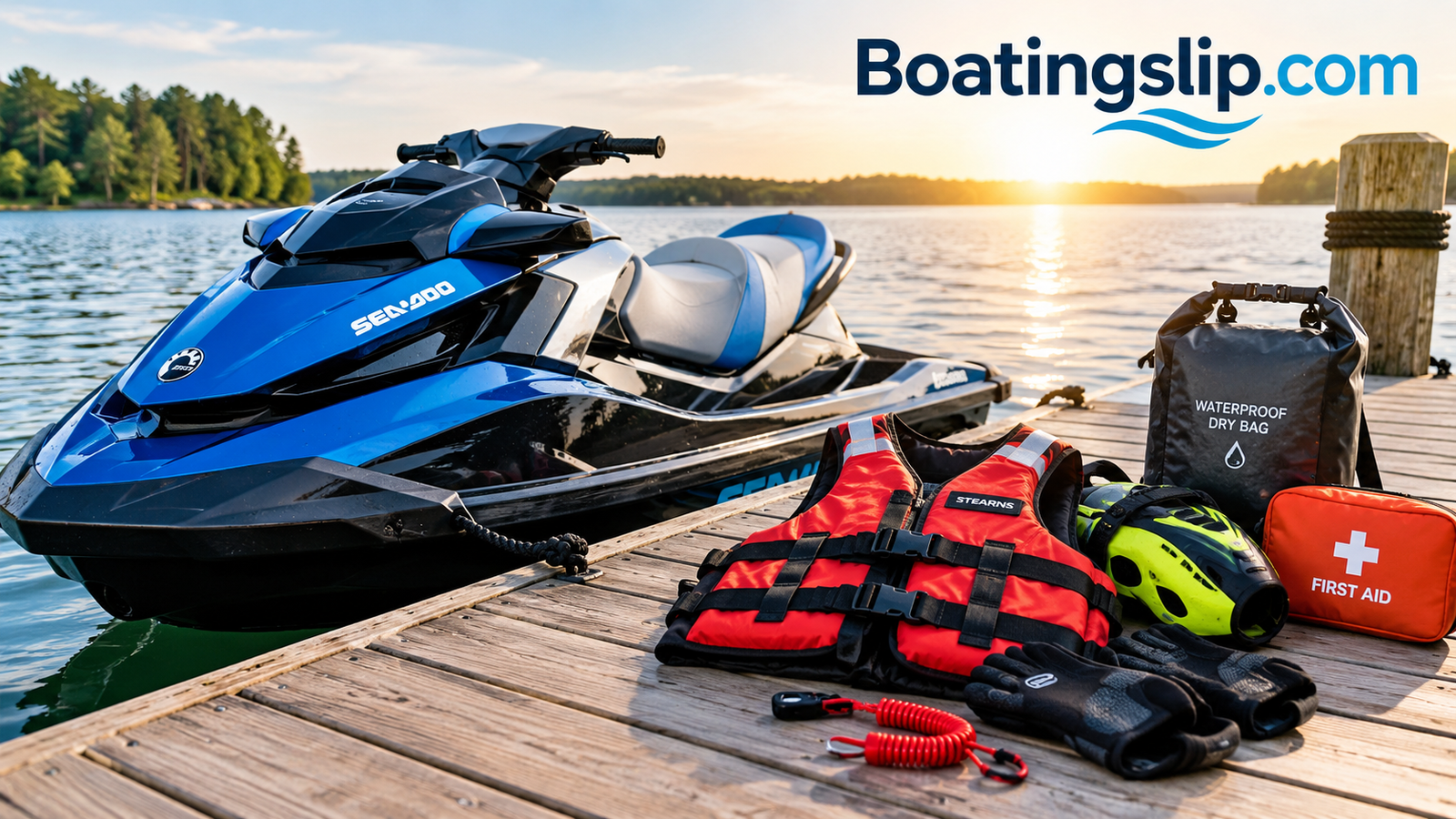
Federal and state rules require specific equipment on every PWC, and most states require every rider to wear a life jacket at all times. Because falls are common, choose a Coast Guard-approved vest rated for high-speed water impact, not a casual foam floatie.
| Item | Why It Matters |
|---|---|
| Coast Guard-approved life jacket | Required for each rider, worn at all times |
| Engine cut-off lanyard | Stops the engine if the rider falls off |
| Fire extinguisher | Often required depending on craft design |
| Sound device or whistle | Signals for help or warns others |
| Mirror and tow rope | Needed if towing skiers or tubers |
Wondering which vest to choose? Our roundup of the best life jackets for adults is a great place to start, and dog owners can see the best dog life jackets too.
Choosing the Right Life Jacket
The life jacket is the single most important piece of equipment on any PWC. Because riders fall at speed and may hit the water hard, a snug, impact-rated vest is far better than a bulky recreational one. Check the label for the Coast Guard approval and the recommended weight range, then try it on and tug the shoulders upward. If it rides up past your chin, it is too loose.
Fit matters just as much for children. A child’s jacket must match their weight, not their age, and should include a crotch strap to prevent slipping off over the head. Test any new vest in shallow water before heading out so you know how it behaves.
The Lanyard and Other Essentials
The engine cut-off lanyard connects the rider to the ignition so that the engine stops if the rider falls off. It is easy to ignore but critical, because a craft left running in circles can injure the rider in the water. Attach it to your life jacket or wrist every time.
Beyond mandatory items, consider a whistle, a waterproof phone case, a small first aid kit, and a bag for registration papers. Gloves and water shoes improve grip and protect your feet. A few small purchases make every ride safer and more comfortable.
Rules of the Water
Legal permission is only the start. Responsible riders learn the rules of the road on the water: keep to the right when meeting head-on, give way to larger vessels, and respect no-wake zones near docks and swimmers.
- Ride only during daylight, as most states prohibit PWC use after sunset.
- Maintain a safe distance from other craft, swimmers, and shorelines.
- Avoid wake jumping close to other boats.
- Never ride under the influence of alcohol or drugs.
Weather can turn quickly, so read our advice on being caught in severe weather while boating before you head out.
Navigation Basics
Every rider should understand right-of-way. When two craft meet head-on, each steers to the right. When crossing, the craft on the right generally has priority. Overtaking craft must stay clear of the one being passed. Sailboats, fishing vessels, and large ships usually have priority over a nimble PWC.
Learning the buoy system helps you read the water like road signs. Red and green markers show channel edges, while white markers with orange symbols warn of hazards or controlled areas. Mastering them takes minutes and prevents groundings and fines.
Courtesy and Environment
Good riders are considerate. Keep a safe distance from anglers, swimmers, docks, and wildlife. Avoid repeated circling in one area, which annoys neighbors and stirs sediment. Slow down near shorelines to reduce wake damage, and obey posted speed and noise limits.
Protect the environment by fueling carefully, avoiding spills, and not riding over shallow vegetation. Clean the hull when moving between lakes. These habits help preserve the places we love and keep access open, since poor behavior often leads to new restrictions on everyone.
Penalties for Riding Without Meeting Requirements
Penalties vary, but common outcomes include fines, a citation requiring proof of course completion, or in serious cases, loss of boating privileges. Riding unregistered, without a life jacket, or while impaired usually carries steeper consequences. Owners who let unqualified people operate their craft may share the liability.
Beyond fines, the real risk is safety: untrained riders are involved in a disproportionate share of PWC accidents.
Fines and Consequences
Penalties depend on the violation. Missing a life jacket or failing to carry registration may produce a modest fine, while reckless operation or riding under the influence can bring heavy penalties, vessel impoundment, or criminal charges. Repeat offenses typically carry escalating consequences.
Insurance can also be affected. If you were violating the law at the time of an accident, a carrier may contest a claim. That can leave you personally responsible for medical bills and property damage, which can reach very high sums quickly.
Civil Liability and Common Sense
Beyond criminal rules, owners face civil liability. If you lend your craft to someone who causes harm, you may share responsibility, especially if that person was unqualified. Always verify that anyone you permit to ride is eligible, understands the rules, and wears proper gear.
The best protection is prevention. Carry your card, keep registration current, stay sober, and ride within your skills. Compliance usually costs far less than a single fine, and it ensures your day ends with good memories instead of a ticket or an emergency call.
How to Stay Out of Trouble
Most citations are easy to avoid. Before each ride, run a quick mental checklist: card, registration, life jackets, lanyard, fuel, and weather. Learn the posted rules at the ramp, since local ordinances can differ from state law. If an officer approaches, stay calm, reduce speed, and cooperate. Being prepared and polite turns most stops into brief, friendly safety checks rather than costly encounters.
Smart Habits for New Riders
Once you are legal, aim to be competent. Practice in calm, open water before tackling crowded areas. Learn how steering depends on throttle, since a jet ski turns poorly with no power applied. Practice falling off and re-boarding so you stay calm when it happens for real.
Dress for the water, not just the weather. Our rundown of the best boating clothes can help, and if you dream of longer trips, the Great Loop shows how far boating can take you.
Build Skills Gradually
Spend your first outings in open, calm water with little traffic. Practice smooth throttle control, wide turns, and stopping safely. Learn how the craft reacts when you ease off the power so you are not startled later. Short sessions with a clear goal beat long, tiring rides where mistakes pile up.
Practice getting back on after a fall. Most PWCs have a boarding step, and reboarding technique saves energy in an emergency. Doing it a few times in calm conditions turns a stressful event into routine.
Plan Every Ride
Check the forecast, wind, and water conditions before you go. Tell someone where you are riding and when you expect to return. Bring a charged phone in a waterproof pouch, enough fuel with a reserve, and drinking water. Wind and waves can make a return trip much harder than the outbound leg.
Finally, ride with a partner whenever possible. Two craft can help each other, and many states require an observer when towing skiers. Safe habits build a lifetime of enjoyment, and the license question becomes a simple step on that path.
Frequently Asked Questions
Do you need a license to ride a jet ski?
Usually you need proof of boater education rather than a traditional license, though rules vary by state and age. The safest assumption is that you do, especially if you are young or riding somewhere new. Even where a card is not strictly required for your age group, carrying one removes any doubt and shows you understand the rules. Always confirm current requirements with your state boating agency before the season starts.
Can you ride a jet ski without a license as an adult?
In some states, older adults are exempt, but many states require a course card for all operators. Check local rules. Some states exempt riders born before a certain date, which is why older adults sometimes ride with only registration. Other states apply the rule to everyone. Because exemptions can change over time, it is smart to check the latest rules rather than rely on what a friend told you years ago.
Do you need a license to rent a jet ski?
Often yes, either a course card or an on-site briefing and test required by the rental company or state. Even when your state does not demand a card from renters, the rental company may set its own policy or require a short test. Bring a photo ID and expect to sign a waiver. Calling ahead saves time and avoids being turned away at the counter.
How old do you have to be to ride a jet ski?
Many states set the minimum between 14 and 16 for solo operation, with supervision rules for younger riders. Minimums differ, and some states allow younger riders only with an adult on board or close supervision. Rental shops often set a higher age than the law does. If a teenager will be riding, confirm both the legal minimum and whether a course card is needed.
How long does it take to get a boater card?
Most online courses take a few hours and the exam can be completed the same day. Many people finish within an afternoon, though self-paced courses let you spread the lessons over several days. After passing the exam you can usually print a temporary card immediately, with a permanent one arriving by mail later.
Does a boater card expire?
In most states it is valid for life, but confirm with your state agency. Most cards are valid for life once earned, which makes the course a one-time effort. Keep a protected copy and know how to request a replacement through the issuing agency if you lose it.
Is a boater card from another state valid?
Many states recognize cards from approved courses, but reciprocity differs, so verify before traveling. States often honor nationally approved courses, but the details of age exemptions and temporary visitor rules vary. Before trailering your jet ski across a border, read the destination state’s rules on cards, registration, and invasive species inspections.
Do you have to register a jet ski?
Yes, nearly all states require registration of motorized PWCs, with numbers displayed on the craft. Registration is typically renewed every year or two and includes displaying numbers and a decal on the hull. Keep the certificate aboard in a waterproof pouch. Riding with expired registration can lead to a fine even if everything else is in order.
Is insurance required for a jet ski?
Rarely by law, but many marinas, lenders, and waterways require it. Even when the law is silent, a policy protects you from large bills after an accident, theft, or damage. Many lenders and marinas require proof of coverage, so shop for a quote before you buy the craft rather than after.
Can you ride a jet ski at night?
Most states prohibit it, restricting PWC use to the period between sunrise and sunset. The restriction exists because visibility is poor and riders are hard to see. Plan to be back at the dock well before sunset, allowing extra time in case of engine trouble or a long ride home against wind and waves.
Do passengers need a license?
No, only the operator, but all passengers must wear life jackets. Passengers do not need a card, but they must follow the same safety rules, including wearing a properly fitted life jacket. Respect the capacity label on your craft, and make sure each passenger knows how to hold on and what to do after a fall.
What happens if I ride without a card?
Expect a fine or citation, plus possible liability if an accident occurs. Officers may issue a citation, require proof of completion later, or in some cases prohibit you from continuing to ride that day. Repeat violations can bring larger penalties, so earning the card is far cheaper and simpler than risking a ticket.
Conclusion
So, do you need a license for a jet ski? In most cases, you need to prove you have completed boater education, register your craft, wear a life jacket, and follow age and daylight rules. The paperwork is simple and cheap compared with the safety, freedom, and peace of mind it buys you.
Ready to hit the water with the right gear?
Gear Up on AmazonYou May Also Like
Top picks for staying safe on the water.
Keep your four-legged crew afloat.
The general rules for every vessel.
State-specific requirements explained.
What rental shops require.
Dress right for any day on the water.
A simple path to certification.
An epic boating adventure.
What to do when conditions turn.